When international buyers source turmeric powder from India, they are buying far more than a spice. They are buying a carefully managed processing chain designed to preserve quality, consistency and export compliance.
Every stage—from selecting turmeric rhizomes to laboratory testing and export packaging—plays a role in delivering a product that meets commercial buyer expectations.
This guide explains how turmeric powder is processed for export and what buyers should evaluate before placing a bulk order.
Why Processing Matters for Export Quality
Professional buyers expect consistency across every shipment. The processing method directly influences colour, aroma, moisture, particle size, cleanliness and shelf life.
Reliable exporters therefore combine proper raw-material selection with controlled processing, quality testing and export-ready packaging.
Our guide on How to Choose a Reliable Turmeric Supplier in India explains why supplier capability matters as much as product quality.
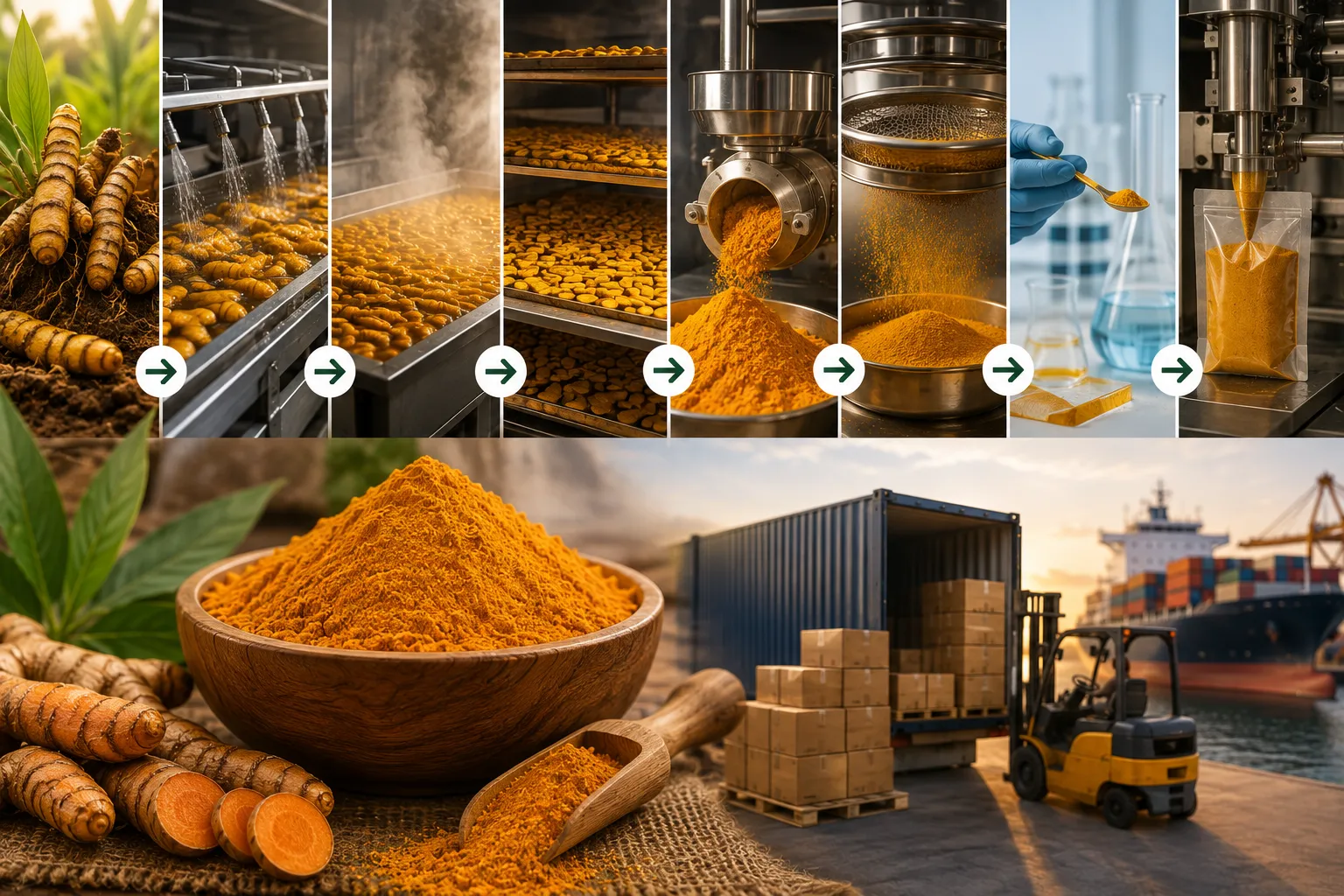
Step 1: Sourcing Premium Turmeric Rhizomes
Everything begins with selecting suitable raw material.
Export-quality turmeric is commonly sourced from established producing regions such as Erode and Sangli, where commercial cultivation supports large-scale supply.
Buyers often consider:
- Variety
- Maturity
- Colour
- Cleanliness
- Uniformity
- Storage condition
High-quality processing cannot fully compensate for poor-quality raw material.
Step 2: Cleaning the Raw Turmeric
Fresh turmeric rhizomes are cleaned to remove soil, dust and unwanted impurities before further processing.
Proper cleaning helps protect product quality throughout the remaining stages.
Step 3: Boiling or Curing
After cleaning, turmeric is typically cured through a controlled boiling or steaming process.
This stage helps prepare the rhizomes for drying while supporting colour development and product consistency.
Processing methods may vary depending on commercial practices and buyer requirements.
Step 4: Drying
Drying is one of the most critical stages.
The objective is to reduce moisture to an appropriate level before grinding.
Drying methods may include:
- Natural drying
- Controlled drying systems
- Commercial drying operations
Proper drying supports shelf life and reduces quality risks during storage and transportation.
Step 5: Grinding Into Powder
Once sufficiently dried, turmeric is milled into powder using commercial processing equipment.
Professional grinding aims to produce:
- Uniform particle size
- Consistent texture
- Even colour
- Reduced contamination risk
The final particle profile depends on the buyer's required mesh specification.
Step 6: Sieving for Consistent Mesh Size
After grinding, the powder is sieved to achieve a more consistent particle size.
International buyers often specify mesh requirements depending on their manufacturing process.
Common commercial discussions involve:
- 80 Mesh
- 100 Mesh
- Custom particle specifications
Our detailed guide on mesh size specifications explains why consistent particle size matters for export ingredients.
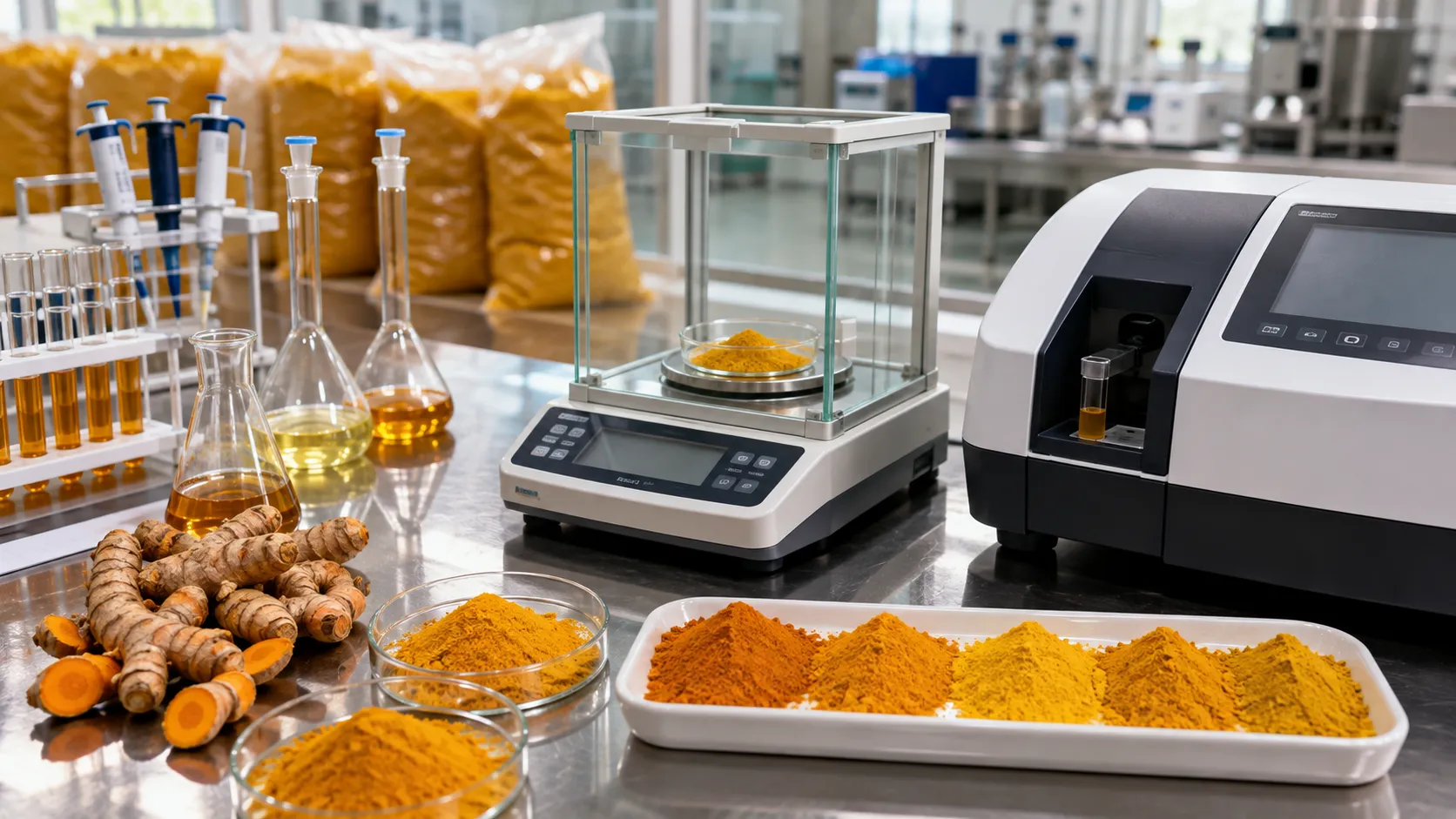
Step 7: Quality Testing
Professional export shipments often undergo quality verification before dispatch.
Depending on customer requirements, testing may include:
- Curcumin percentage
- Moisture
- Ash
- Microbiological parameters
- Heavy metals
- Product appearance
Laboratory documentation helps buyers verify that shipments match agreed specifications.
Our article on Turmeric Powder Specifications explains these quality parameters in detail.
Step 8: Export Packaging
Packaging protects turmeric throughout international transportation.
Common commercial options include:
- 25 kg PP bags
- 50 kg PP bags
- Food-grade inner liners
- Kraft paper bags
- Customized packaging
- Private-label packaging
The appropriate packaging depends on buyer requirements, shipment size and destination.
Step 9: Export Documentation and Shipment
Before international dispatch, exporters prepare commercial documentation required for the shipment.
Depending on the transaction, documentation may include:
- Commercial Invoice
- Packing List
- Certificate of Origin
- Certificate of Analysis
- Phytosanitary documentation where applicable
- Bill of Lading
Accurate documentation helps reduce unnecessary delays during international trade.
How Buyers Should Evaluate Processing Quality
Rather than judging turmeric by colour alone, professional buyers should evaluate the complete processing chain.
Evaluating the complete process helps buyers reduce sourcing risk.
How HMT Exim Supports Export Buyers
HMT Exim sources turmeric from established Indian production regions and emphasizes quality-focused inspections, laboratory documentation where applicable, export-ready packaging and shipment coordination for international buyers. The company's product profile highlights export-oriented sourcing from Erode and Sangli alongside flexible packaging options.
Learn more on our Turmeric Powder product page.
Frequently Asked Questions
Does export turmeric undergo laboratory testing?
Many commercial shipments include laboratory documentation depending on buyer requirements.
Why is drying important?
Proper drying supports shelf life, storage stability and export quality.
What mesh size is commonly discussed?
Commercial buyers frequently discuss specifications such as 80 Mesh, 100 Mesh and customized particle sizes.
Can exporters provide customized packaging?
Yes. Many export shipments can be packed according to buyer branding and packaging requirements.
How should buyers choose a supplier?
Evaluate sourcing quality, processing capability, testing, packaging and documentation support—not only price.
Final Takeaway
Export-quality turmeric powder is the result of a carefully managed process rather than a single manufacturing step.
From sourcing premium rhizomes to grinding, laboratory testing, packaging and documentation, each stage contributes to product consistency and buyer confidence.
If you're looking for export-quality turmeric powder from India, contact HMT Exim to discuss your specifications, packaging and destination market.