For international buyers, turmeric powder specifications determine whether a shipment will meet production requirements, regulatory expectations and commercial quality standards. Many sourcing decisions focus on price, but professional procurement teams compare detailed technical specifications before approving a supplier.
Whether you're importing turmeric for food manufacturing, spice blending or nutraceutical production, understanding specifications such as curcumin, moisture, mesh size and purity can help reduce sourcing risks and improve long-term supplier relationships.
This guide explains the most important turmeric powder specifications buyers should understand before placing a bulk order from India.
Why Turmeric Powder Specifications Matter
Two suppliers may both offer "turmeric powder," but their products can differ significantly in particle size, moisture content, laboratory testing and commercial specifications.
A written specification helps buyers:
- Compare suppliers fairly
- Reduce quality disputes
- Improve production consistency
- Define laboratory requirements
- Align commercial expectations
Instead of requesting only "turmeric powder," buyers should provide a complete technical specification before requesting quotations.
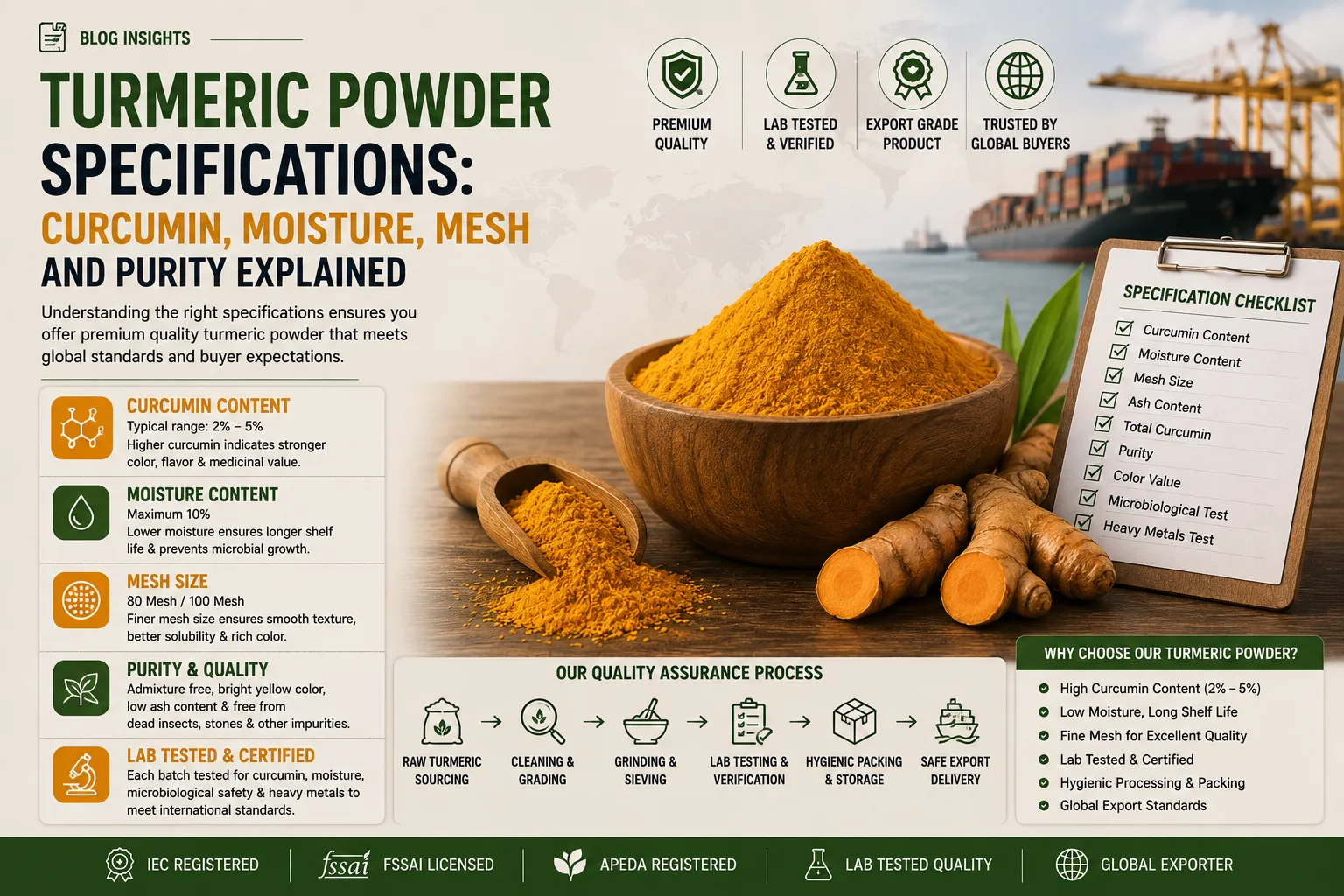
The Four Core Turmeric Specifications
| Specification | Purpose |
|---|---|
| Curcumin or Curcuminoids | Product specification |
| Moisture | Storage stability |
| Mesh Size | Particle consistency |
| Purity | Quality assurance |
These four specifications form the foundation of most commercial turmeric quotations.
Curcumin Specification Explained
Curcumin is one of the naturally occurring curcuminoids found in turmeric and is one of the most frequently requested commercial specifications.
Buyers commonly encounter:
- 2%
- 3%
- 3.5%
- 4%
However, before comparing suppliers, buyers should confirm:
- Whether the percentage refers to curcumin or total curcuminoids
- The analytical method used
- The reporting basis
- The agreed specification tolerance
Our detailed guide on What Is Curcumin in Turmeric? explains how buyers should interpret these specifications.
Moisture Content
Moisture is an important commercial specification because it affects storage and handling.
Before purchasing, buyers should establish:
- Maximum acceptable moisture level
- Testing method
- Reporting basis
Moisture should be evaluated together with packaging and storage requirements rather than treated as an isolated parameter.
Mesh Size Explained
Mesh size describes the particle size of powdered turmeric rather than its overall quality.
Commercial buyers may request different mesh specifications depending on their production process.
Instead of requesting "fine powder," buyers should specify the required mesh or particle-size range in writing.
| Mesh Consideration | Why It Matters |
|---|---|
| Particle consistency | Manufacturing performance |
| Blending | Uniform mixing |
| Processing | Equipment compatibility |
Purity Specification
Purity helps define what the buyer expects from the finished product.
Rather than assuming purity from appearance alone, buyers should request:
- Product specification
- Laboratory documentation
- Foreign matter requirements
- Applicable quality parameters
Purity should always be documented before commercial production begins.
Other Specifications Buyers Should Consider
While the four core specifications are essential, professional buyers often include additional technical requirements.
Microbiological Requirements
Depending on the destination market, buyers may request microbiological testing.
Requirements vary according to the intended application.
Heavy Metals
Some buyers require laboratory testing for heavy metals as part of their quality-control process.
Pesticide Residues
Destination-country requirements may determine whether pesticide-residue testing is required.
Packaging
Packaging is an important part of the overall specification.
Common commercial options include:
- 25 kg PP bags
- 50 kg PP bags
- Food-grade liners
- Kraft paper bags
- Private-label packaging where commercially arranged
How a Professional Turmeric Specification Looks
A complete buyer specification should define multiple parameters together rather than relying on a single percentage.
| Specification Area | Buyer Should Define |
|---|---|
| Curcumin | Required specification |
| Moisture | Maximum level |
| Mesh | Required particle size |
| Purity | Commercial requirement |
| Packaging | Required pack size |
| Quantity | Commercial volume |
This written specification becomes the reference point for quotations, production and quality verification.
How Buyers Should Compare Supplier Quotations
Instead of comparing quotations only by price, buyers should verify:
- Curcumin specification
- Moisture
- Mesh size
- Purity
- Laboratory documentation
- Packaging
- Commercial terms
- Export capability
This creates a more meaningful comparison between suppliers.
Sample Approval Before Bulk Production
A representative sample provides an opportunity to compare the physical product with the written specification before approving commercial production.
Buyers should compare:
- Colour
- Texture
- Particle consistency
- Packaging
- Laboratory documentation
Sample approval helps establish a reference point for future shipments.
Supplier Verification Matters Too
Even a strong product specification is only effective when the supplier can consistently meet it.
Before placing a commercial order, buyers should review business registration, documentation, communication and export capability.
Our guide on How to Choose a Reliable Turmeric Supplier in India explains this process.
Turmeric Buyer's Specification Checklist
- ☐ Curcumin requirement defined
- ☐ Moisture specification confirmed
- ☐ Mesh size documented
- ☐ Purity requirement defined
- ☐ Laboratory testing requirements agreed
- ☐ Packaging confirmed
- ☐ Sample approved
- ☐ COA requirements documented
- ☐ Commercial quotation matches the specification
- ☐ Export documentation confirmed
HMT Exim's Quality-Focused Approach
HMT Exim supports international buyers by coordinating product sourcing, quality-focused inspections, export-ready packaging and documentation for Indian turmeric products.
Buyers can review the Turmeric Powder product page or contact HMT Exim to discuss their required specifications, quantities and destination requirements.
Frequently Asked Questions
What are the most important turmeric powder specifications?
Curcumin, moisture, mesh size and purity are among the most commonly requested commercial specifications.
Is higher curcumin always better?
No. The correct specification depends on the intended application and buyer requirements.
What does mesh size mean?
Mesh describes particle size rather than overall product quality.
Should buyers request a COA?
Yes. A Certificate of Analysis helps buyers compare laboratory results with the agreed specification.
Should the product specification appear in the purchase order?
Yes. The written specification should be reflected consistently across the quotation, purchase order and quality documentation.
Final Takeaway
Professional turmeric sourcing starts with a detailed written specification rather than simply requesting "turmeric powder." Buyers who define curcumin, moisture, mesh size, purity and laboratory requirements before requesting quotations are better positioned to receive consistent commercial quality.
If you already know your required turmeric specifications, contact HMT Exim to discuss your sourcing requirements.