For international buyers, evaluating Psyllium Husk before a bulk purchase is about more than comparing prices. Product quality, consistency, testing, packaging and documentation can all affect the performance of the ingredient in food, nutraceutical and dietary-fiber applications.
Buyers should define their technical requirements before requesting quotations and confirm that the supplier can consistently meet those requirements across commercial shipments.
What Should Buyers Check When Evaluating Psyllium Husk?
A practical Psyllium Husk quality assessment should consider several parameters together rather than relying on a single specification.
- Purity and cleanliness
- Swelling index
- Moisture content
- Particle or mesh size
- Colour and appearance
- Odour and overall condition
- Foreign matter
- Microbiological quality
- Packaging and storage conditions
- Certificate of Analysis and supporting documentation
1. Check Psyllium Husk Purity
Purity is one of the first specifications buyers should define when sourcing Psyllium Husk in bulk. Different applications can require different purity levels, so the buyer should specify the required grade rather than assuming that every Psyllium Husk product is equivalent.
The agreed purity specification should be clearly stated in the quotation, product specification sheet and purchase documentation. Where applicable, buyers should also request testing documentation supporting the stated specification.
2. Evaluate Swelling Index
Swelling behaviour is an important quality consideration for Psyllium Husk because the ingredient is commonly used for its water-absorbing and fibre-forming properties.
Buyers should specify the required swelling index and confirm the test method used by the supplier or laboratory. Comparing results is more meaningful when samples are tested using the same method and conditions.
A supplier quotation should therefore not simply state that the product has a high swelling capacity. The buyer should request the actual specification and supporting test information.
3. Check Moisture Content
Moisture can influence the storage stability and physical condition of bulk Psyllium Husk. Buyers should establish an acceptable moisture specification before confirming an order.
The agreed moisture requirement should be included in the product specification and verified through the applicable quality-control process. Proper packaging and dry storage conditions are also important throughout transportation and storage.
4. Confirm Mesh or Particle Size
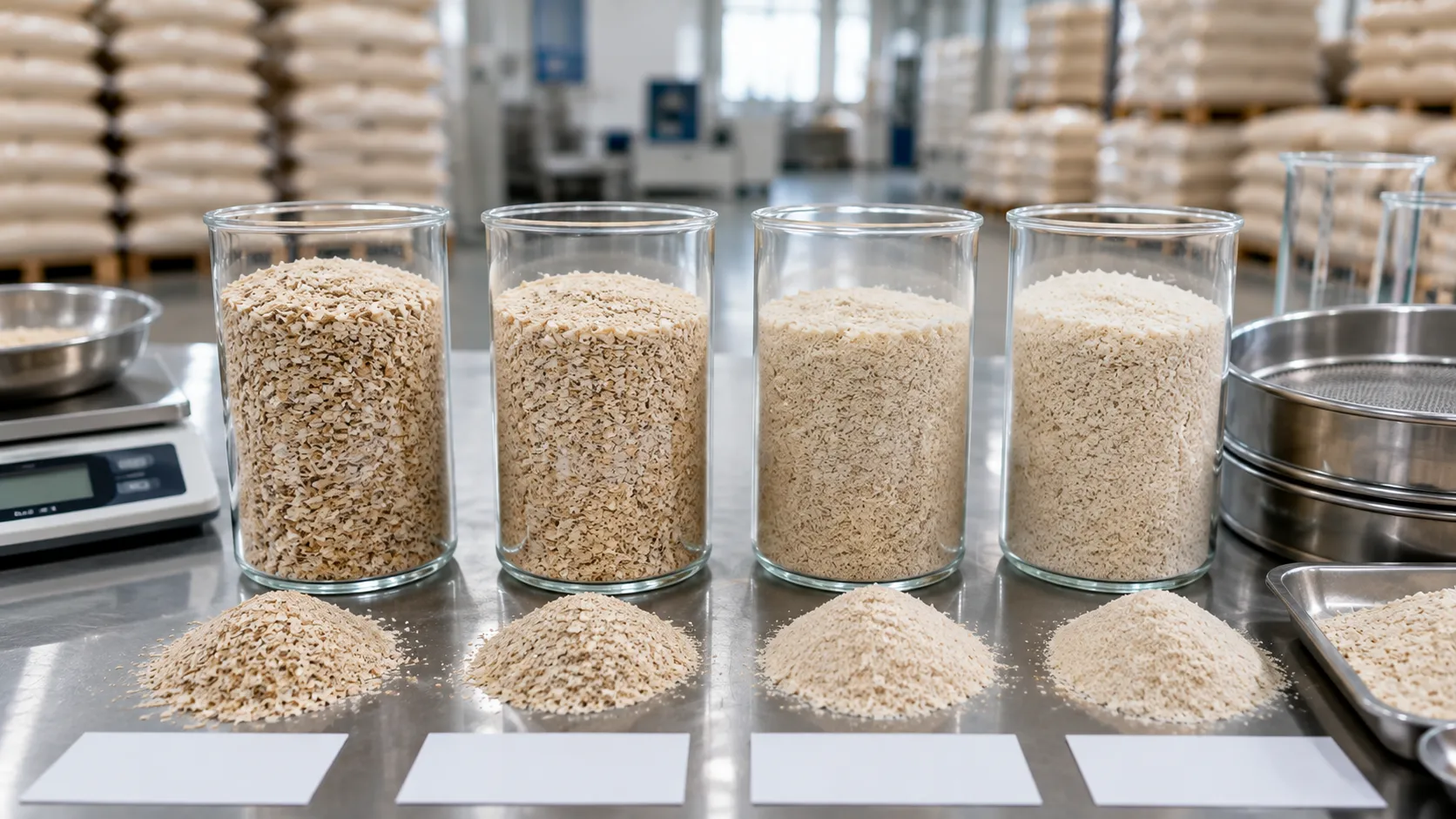
Particle size becomes particularly important when buying Psyllium Husk powder or material intended for a specific formulation process.
Different applications may require different particle sizes. A buyer should therefore specify the required mesh or particle-size range instead of accepting a generic description such as fine powder.
For whole Psyllium Husk, the buyer should also clarify whether the requirement concerns whole husk, cleaned husk or another processed form.
5. Examine Colour, Appearance and Odour
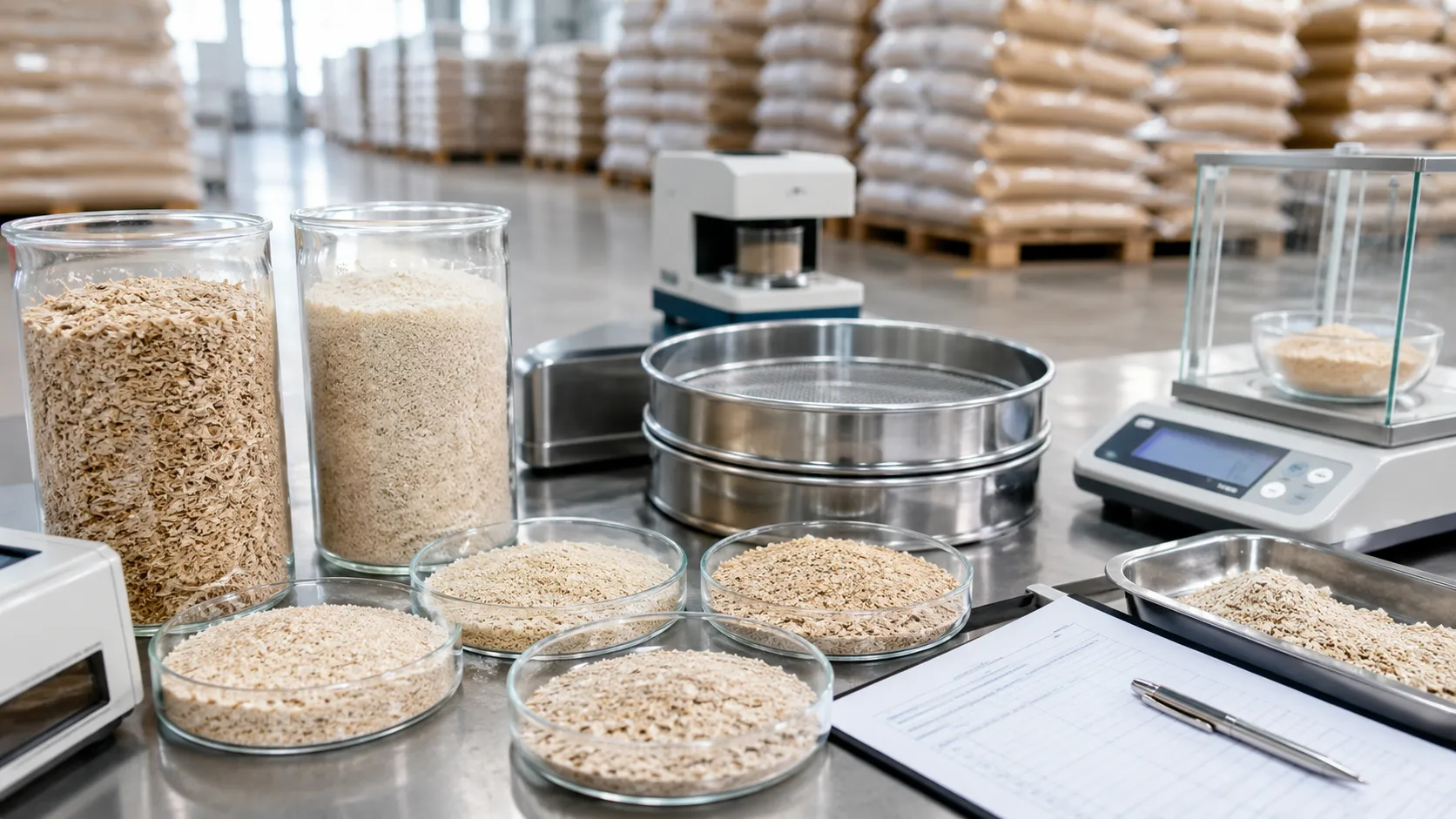
Physical appearance can provide useful preliminary information about a Psyllium Husk sample, although visual inspection should not replace laboratory testing.
Buyers can compare samples for:
- Uniformity of appearance
- Colour consistency
- Visible foreign matter
- Unusual odour
- Signs of excessive moisture or poor storage
These checks are particularly useful when comparing samples from multiple suppliers before moving to commercial quantities.
6. Check Microbiological and Safety Parameters
For food, nutraceutical and dietary-fibre applications, buyers should establish the microbiological and safety requirements applicable to their intended market and end use.
Depending on the destination and application, buyers may need relevant testing for parameters such as total plate count, yeast and mould, pathogens, heavy metals, pesticide residues or other regulated contaminants.
The exact requirements should be determined according to the destination market, product application and applicable regulations rather than using one universal specification for every shipment.
7. Request a Certificate of Analysis
A Certificate of Analysis, or COA, helps a buyer compare the supplied product against agreed specifications.
A useful COA should clearly identify the product or batch and report the parameters that are relevant to the agreed specification.
Before accepting a commercial shipment, buyers should compare the COA with the purchase specification rather than treating the presence of a COA alone as proof of quality.
8. Evaluate Packaging and Storage
Even a good-quality product can be affected by inappropriate packaging or storage conditions.
Before placing an order, confirm:
- Packaging material
- Pack size
- Food-contact requirements where applicable
- Inner liner requirements
- Protection against moisture
- Batch identification and labelling
- Storage recommendations
Packaging should be suitable for the planned transportation route, destination climate and expected storage period.
9. Compare the Sample With the Commercial Specification
A common sourcing mistake is approving a sample without defining how the commercial shipment will be evaluated.
Before placing a bulk order, buyers should convert the approved sample requirements into a written product specification. This creates a clear reference point for production, quality inspection and shipment acceptance.
If you are new to sourcing Psyllium Husk from India, our Psyllium Husk B2B sourcing guide provides additional guidance on supplier and product evaluation.
10. Verify the Exporter Before the Order
Product specifications are only one part of supplier due diligence. Buyers should also verify the exporter, business information, documentation and commercial communication before committing to a large order.
Our guide on how to verify an Indian exporter provides a practical framework for evaluating an Indian supplier before placing an international order.
Psyllium Husk Quality Checklist for International Buyers
- ☐ Required purity level is defined
- ☐ Swelling index requirement is defined
- ☐ Moisture specification is defined
- ☐ Mesh or particle-size requirement is defined
- ☐ Appearance and colour requirements are agreed
- ☐ Foreign matter requirement is defined
- ☐ Microbiological requirements are confirmed
- ☐ Destination-specific safety requirements are reviewed
- ☐ COA requirements are agreed
- ☐ Packaging specification is confirmed
- ☐ Sample has been evaluated
- ☐ Commercial specification matches the approved sample
- ☐ Supplier documentation has been reviewed
Why a Written Product Specification Matters
A written specification gives both buyer and supplier a common reference for the transaction. It reduces ambiguity around quality expectations and makes it easier to compare quotations from different suppliers.
The specification should be agreed before the commercial order and should correspond with the quotation, purchase documentation and quality-control process.
From Product Evaluation to Export Shipment
Once the product specification and supplier have been approved, buyers should also understand the broader transaction process, including commercial documentation, packing, customs procedures and international shipment. Our complete export process from India guide explains the major stages involved.
For buyers evaluating Psyllium Husk specifically, you can also review HMT Exim's Psyllium Husk product information and discuss your required specification, quantity and destination with the export team through the HMT Exim contact page.
Frequently Asked Questions
What is the most important Psyllium Husk quality parameter?
There is no single parameter that is most important for every buyer. Purity, swelling index, moisture, particle size, microbiological quality and other requirements should be evaluated according to the intended application and destination market.
Should buyers test a Psyllium Husk sample before a bulk order?
Yes. A representative sample can help buyers evaluate whether the product meets their agreed technical requirements before committing to a larger commercial quantity.
What should be included in a Psyllium Husk specification?
A specification can include purity, swelling index, moisture, particle size, appearance, microbiological requirements, safety parameters, packaging and other application-specific requirements.
Is a Certificate of Analysis enough to verify Psyllium Husk quality?
A COA is useful supporting documentation, but buyers should evaluate it against the agreed specification and use appropriate supplier and product due diligence.
Can Psyllium Husk specifications vary between buyers?
Yes. Requirements can differ according to application, processing method, destination market, packaging and buyer quality standards.
Final Takeaway
Successful Psyllium Husk sourcing starts with a clear specification rather than simply selecting the lowest quotation. International buyers should evaluate purity, swelling behaviour, moisture, particle size, safety parameters, packaging, documentation and supplier reliability together.
If you have a specific Psyllium Husk specification, quantity or destination requirement, contact HMT Exim to discuss your sourcing requirement.