Exporting a product from India involves much more than finding a buyer and arranging transportation. A successful international shipment requires clear product specifications, commercial terms, quality control, export documentation, packaging, logistics coordination and customs procedures.
For an international buyer, understanding the export process helps reduce misunderstandings, delays and unexpected costs.
For a new exporter, understanding the complete workflow helps create a more professional and repeatable export operation.
This guide explains the typical export process from India from the first buyer inquiry to the final shipment.
Quick Answer: What Is the Export Process From India?
The typical export process follows these stages:
- Identify the product and target market
- Receive or identify a buyer inquiry
- Confirm product specifications
- Discuss quantity and packaging
- Provide an export quotation
- Arrange samples when required
- Confirm commercial terms
- Receive order confirmation
- Arrange procurement or production
- Conduct quality inspection
- Prepare export packaging
- Prepare export documentation
- Book freight and plan shipment
- Complete export customs procedures
- Load and dispatch the shipment
- Provide shipping documents
- Track the shipment through delivery
The exact process can change depending on the product, destination country, buyer requirements, shipping method and agreed Incoterms.
Step 1: Identify the Product and Target Market
Before an export transaction begins, the exporter should understand exactly what product is being offered and where it can be sold.
For agricultural products and food ingredients, this may involve researching:
- Product demand
- Import regulations
- Required certifications
- Product specifications
- Packaging requirements
- Competitor pricing
- Freight costs
- Potential buyers
- Destination-country requirements
For example, a turmeric exporter may need to define the required curcumin level, mesh size, moisture specification and packaging before approaching an international buyer.
The same principle applies to psyllium husk, cumin and other agricultural products.
Step 2: Receive an International Buyer Inquiry
The export transaction commonly begins when a buyer contacts the supplier.
A useful buyer inquiry should ideally contain:
- Product name
- Required quantity
- Required grade
- Technical specifications
- Packaging requirement
- Destination country
- Destination port
- Required documents
- Preferred Incoterm
- Expected shipment timeline
If important information is missing, the exporter should clarify the requirement before preparing a final quotation.
What Information Should a Buyer Send to an Indian Exporter?
A buyer can make the sourcing process faster by providing a clear requirement such as:
Product: Turmeric Powder
Quantity: 5 MT
Specification: Buyer-defined curcumin and mesh requirement
Packaging: 25 kg bags
Destination: Buyer port
Required documents: As applicable
Preferred trade term: FOB or CIF
The exact specification should be agreed between buyer and exporter before the commercial order is finalized.
Step 3: Confirm the Product Specification
Product specifications should be agreed before price confirmation whenever possible.
For spices and agricultural ingredients, specifications can include:
- Grade
- Purity
- Moisture
- Mesh size
- Active or quality parameters
- Colour
- Foreign matter
- Microbiological requirements
- Heavy metals where applicable
- Shelf life
- Packaging
This is one of the most important stages of the export process.
A price without a clearly defined product specification can lead to misunderstandings later.
Step 4: Discuss Quantity and Packaging
Quantity and packaging directly affect the export quotation.
The exporter should confirm:
- Total quantity
- Bag size
- Number of bags
- Inner liner requirement
- Pallet requirement
- Private-label requirement
- Container requirements
- Destination handling conditions
HMT Exim's current product material describes export packaging options including 25 kg and 50 kg PP bags, vacuum packs and customized branding.
Step 5: Request or Evaluate a Sample
Depending on the product, buyers may request samples before approving a bulk order.
A sample allows the buyer to evaluate characteristics such as:
- Appearance
- Colour
- Aroma
- Purity
- Texture
- Product specifications
- Packaging
For products where laboratory parameters are important, the buyer may also request a Certificate of Analysis or independent testing.
A sample should not be treated as a substitute for agreed bulk-shipment specifications. The final commercial specification should be documented separately.
Step 6: Prepare the Export Quotation
Once the product requirement is clear, the exporter can prepare a quotation.
A professional quotation should clearly identify:
| Quotation Element | What Should Be Specified |
|---|---|
| Product | Exact product name and grade |
| Quantity | Total quantity and unit |
| Specification | Agreed technical parameters |
| Packaging | Bag size and packaging type |
| Price | Unit and total price |
| Incoterm | Agreed delivery term |
| Port | Port of loading or destination where applicable |
| Payment | Agreed payment arrangement |
| Validity | Quotation validity period |
| Lead Time | Expected preparation timeline |
The buyer should compare complete quotations rather than comparing only the product price.
Step 7: Agree on Incoterms
International buyers and exporters should clearly agree on the applicable Incoterm.
Common terms discussed in export transactions include:
- EXW
- FOB
- CFR
- CIF
The chosen term affects which party is responsible for different parts of transportation, costs and risk.
For example, under FOB, the buyer generally arranges the main carriage, while under CIF the seller arranges the cost, insurance and freight to the named destination port under the applicable rule.
The exact Incoterm should be clearly written in the commercial agreement or quotation.
Step 8: Confirm Payment Terms
Payment terms should be agreed before the order is processed.
Depending on the transaction, commercial arrangements can include:
- Advance payment
- Balance payment
- Letter of Credit
- Other mutually agreed arrangements
The exporter and buyer should clearly document:
- Payment percentage
- Payment timing
- Bank details
- Currency
- Conditions attached to the payment
Buyers should independently verify bank details before making international payments.
Step 9: Confirm the Order
After the buyer accepts the quotation, the transaction moves toward order confirmation.
Commercial records can include:
- Purchase Order
- Sales Order
- Proforma Invoice
- Order confirmation
- Product specification sheet
The final documents should match the agreed product, quantity, packaging and commercial terms.
Step 10: Procurement or Production
The exporter then arranges the required product quantity.
For agricultural products and spices, sourcing is an important part of quality management.
HMT Exim's company material describes sourcing from farmers and APMC markets including Unjha, Sangli and Erode, depending on the product.
The sourcing stage can involve:
- Supplier selection
- Lot selection
- Product inspection
- Quantity confirmation
- Processing
- Cleaning
- Grading
- Packing preparation
Step 11: Quality Inspection
Quality inspection should be performed according to the agreed product specification.
Depending on the product, checks can include:
- Visual appearance
- Purity
- Moisture
- Mesh size
- Product-specific parameters
- Foreign matter
- Microbiological testing
- Heavy metals where applicable
- Packaging condition
- Quantity
For turmeric, for example, a buyer may specify curcumin, moisture and mesh requirements.
For psyllium husk, buyers may specify purity, mesh and swelling characteristics.
The important point is that quality control should be connected to the actual buyer specification.
Step 12: Prepare Export Packaging
The packaging must protect the product during:
- Handling
- Container loading
- Ocean transportation
- Port storage
- Unloading
- Warehouse storage
For agricultural products, protection against moisture and contamination can be particularly important.
Packaging should therefore be selected based on:
- Product characteristics
- Shipment duration
- Destination climate
- Buyer requirements
- Storage conditions
- Transportation method
Step 13: Prepare Export Documentation
Export documentation is a critical part of the shipment.
Depending on the transaction and destination, documents can include:
- Commercial Invoice
- Packing List
- Certificate of Origin
- Bill of Lading
- Certificate of Analysis
- Phytosanitary Certificate where applicable
- Fumigation Certificate where applicable
- Shipping Bill
- Other destination-specific documents
Not every shipment requires exactly the same document set.
The product, destination country and importing requirements determine which documents are applicable.
What Is a Commercial Invoice?
The commercial invoice records important commercial information about the transaction.
It generally identifies information such as:
- Exporter
- Buyer
- Product
- Quantity
- Price
- Currency
- Total value
- Trade terms
- Invoice number
- Shipment information
The exact requirements should be checked against the applicable transaction and regulations.
What Is a Packing List?
The packing list provides shipment and package information.
It can include:
- Number of packages
- Package type
- Net weight
- Gross weight
- Product description
- Dimensions where relevant
- Marks and numbers
The packing list should be consistent with the commercial invoice and physical shipment.
What Is a Certificate of Origin?
A Certificate of Origin identifies the country of origin of the goods.
Whether it is required and which form is accepted depends on the destination and transaction.
What Is a Certificate of Analysis?
A Certificate of Analysis provides laboratory or quality information for the product according to the applicable testing requirements.
For food ingredients and agricultural products, buyers may request a COA containing relevant technical parameters.
What Is a Phytosanitary Certificate?
A phytosanitary certificate is used for certain plant and plant-product shipments where required by the importing country's plant-health requirements.
It should not be assumed that every product or every destination requires the same certificate.
Step 14: Freight Booking
After the shipment is ready or sufficiently planned, freight arrangements are made according to the agreed commercial terms.
The logistics process can involve:
- Freight forwarder
- Shipping line
- Container booking
- Port coordination
- Cargo movement
- Export documentation
- Customs procedures
The shipment method depends on the product, quantity, destination and commercial agreement.
Step 15: Container Loading
For containerized shipments, the cargo needs to be loaded carefully.
The loading process should consider:
- Package condition
- Weight distribution
- Moisture protection
- Product stability
- Available container space
- Safe handling
- Buyer requirements
Proper loading helps reduce avoidable damage during transportation.
Step 16: Export Customs Clearance
Before goods leave India, the shipment must complete the applicable export customs process.
The exporter or appointed logistics/customs professionals coordinate the required procedures and documentation.
Documentation discrepancies can cause delays, which is why shipment information should be checked before cargo dispatch.
Step 17: Shipment
Once the shipment has completed the applicable export procedures and is handed over for international transportation, the cargo moves toward the destination.
For ocean freight, the cargo travels from the Indian port of loading to the destination port.
The actual transit time depends on the shipping route, carrier, port conditions and destination.
Step 18: Shipping Documents Are Shared With the Buyer
After shipment, the exporter provides the applicable shipping documents according to the transaction and payment terms.
These may include:
- Bill of Lading
- Commercial Invoice
- Packing List
- Certificate of Origin
- Certificate of Analysis
- Other applicable certificates
The buyer uses the relevant documents for import procedures, customs clearance and receiving the shipment.
Step 19: Import Clearance and Delivery
After arrival at the destination, the buyer or its appointed customs and logistics partners generally handle the applicable import procedures.
These can include:
- Import documentation
- Customs clearance
- Duties and taxes
- Port charges
- Inland transportation
- Warehouse delivery
The responsibilities depend on the agreed Incoterm and destination-country regulations.
Complete Export Process at a Glance
Buyer Inquiry
↓
Product Specification
↓
Quotation
↓
Sample Approval
↓
Commercial Agreement
↓
Order Confirmation
↓
Procurement or Production
↓
Quality Inspection
↓
Packaging
↓
Export Documentation
↓
Freight Booking
↓
Customs Clearance
↓
Container Loading and Dispatch
↓
International Shipment
↓
Shipping Documents
↓
Import Clearance
↓
Final Delivery
What Causes Export Delays?
Several issues can affect shipment timelines.
Common causes include:
- Incomplete buyer specifications
- Changes after order confirmation
- Packaging delays
- Quality issues
- Missing documentation
- Incorrect shipment information
- Freight availability
- Customs documentation discrepancies
- Destination-country requirements
- Port or carrier delays
Not every delay is controlled by the exporter, which is why realistic planning and communication are important.
What Should an International Buyer Confirm Before Ordering?
Before placing an order with an Indian exporter, confirm:
- Product specification
- Quantity
- Packaging
- Price
- Incoterm
- Payment terms
- Destination port
- Required documents
- Quality requirements
- Sample approval
- Shipment timeline
- Responsibilities of buyer and seller
Having these points documented reduces the possibility of misunderstandings.
What Should a New Indian Exporter Focus On?
A new exporter should build a repeatable process rather than treating every shipment as a completely new project.
The core areas are:
- Buyer qualification
- Product specification
- Supplier selection
- Quality control
- Documentation
- Packaging
- Logistics
- Payment management
- Customer communication
Professional export operations depend on coordination between all of these areas.
HMT Exim's Export Approach
HMT Exim is an India-based export business operating from Surat, Gujarat.
The company's current business materials describe a sourcing approach involving farmers and APMC markets, quality checks for parameters such as purity, moisture and curcumin where applicable, export-ready packaging, and support for international buyers.
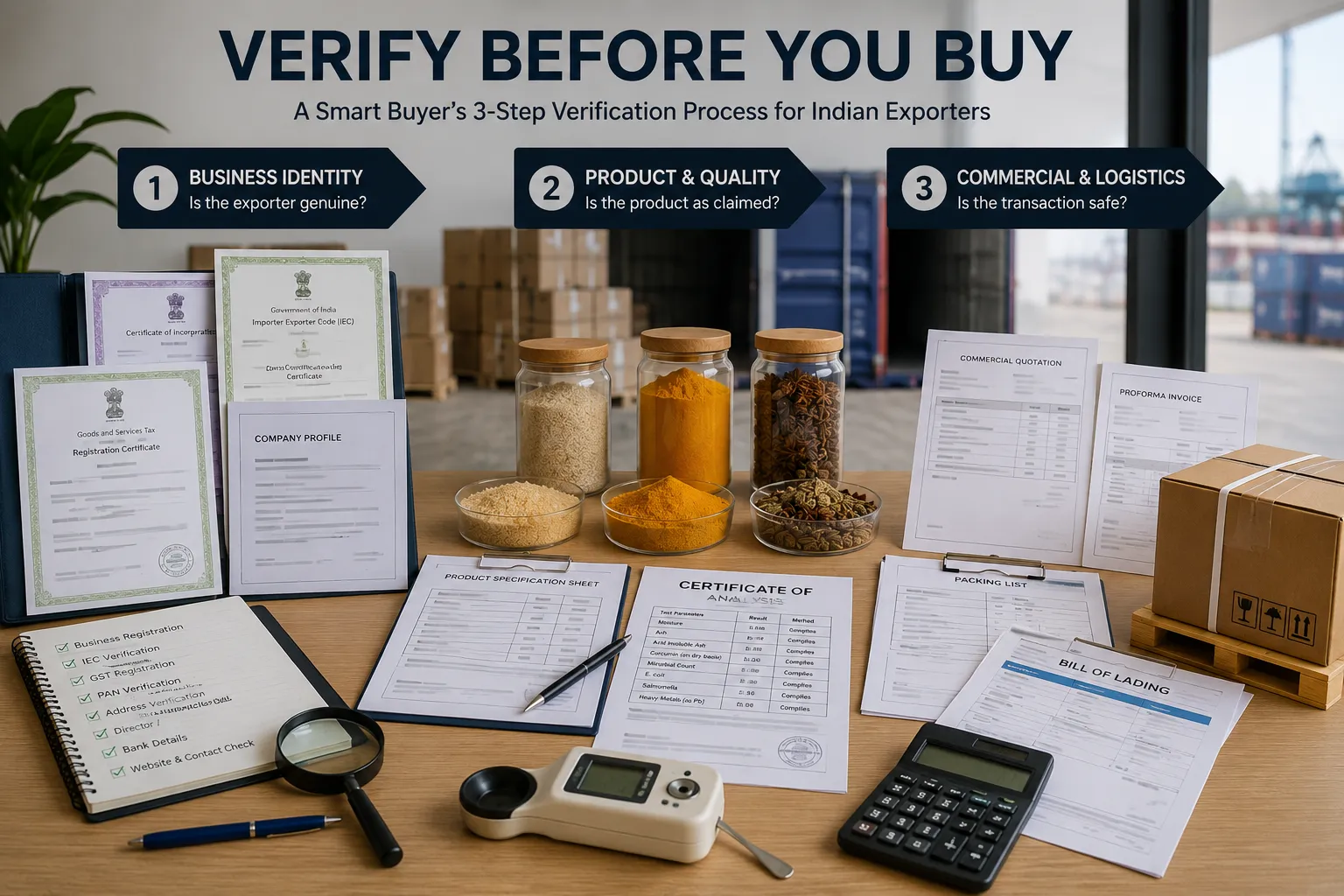
HMT Exim also holds an Importer-Exporter Code issued by the Directorate General of Foreign Trade and is registered as a proprietorship.
The business is also registered under Udyam as a micro enterprise with wholesale trading as its major activity.
HMT Exim's GST registration identifies HMT Exim as its trade name and records its business constitution as a proprietorship.
These credentials are part of the basic business verification information buyers can review when evaluating an Indian supplier.
Key Takeaways
The export process from India is a chain of connected activities rather than a single procedure.
The most important stages are:
- Define the product correctly
- Understand the buyer's requirements
- Confirm specifications before pricing
- Provide a clear quotation
- Approve samples where required
- Confirm commercial terms
- Procure or process the product
- Perform quality checks
- Use suitable export packaging
- Prepare accurate documentation
- Coordinate freight and customs
- Complete shipment
- Provide the required shipping documents
- Coordinate with the buyer through delivery
The strongest export transactions are built on clear specifications, accurate documentation, quality control and communication.
Frequently Asked Questions
What is the first step in exporting from India?
The first practical step is identifying the product and market requirement, followed by obtaining a clear buyer inquiry or defining the target buyer requirement.
What documents are required for export from India?
The required documents depend on the product, destination and transaction. Common documents can include a commercial invoice, packing list, shipping documents, certificate of origin and product-specific certificates.
Does every export shipment require a phytosanitary certificate?
No. Requirements depend on the product and destination country's applicable regulations.
What is the difference between FOB and CIF?
FOB and CIF allocate transportation responsibilities differently. Under FOB, the buyer generally arranges the main carriage. Under CIF, the seller arranges cost, insurance and freight to the named destination port under the applicable rule.
Should an importer request a sample before a bulk order?
For many products, sample evaluation is a practical way to confirm that the product meets the buyer's requirements before a larger commercial shipment.
How is export quality checked?
Quality checks depend on the product specification. They can include visual inspection, moisture, purity, mesh size, product-specific parameters and laboratory testing where applicable.
How is an export shipment packed?
Packaging depends on the product, destination, shipment duration, handling conditions and buyer requirements.
How long does an export shipment from India take?
There is no single standard timeline. Procurement, processing, documentation, customs, freight availability, shipping route and destination all affect the overall timeline.
Who handles customs clearance?
Export-side customs procedures are generally coordinated by the exporter and its appointed logistics or customs professionals, while destination import clearance is generally handled according to the agreed commercial terms and local requirements.
Can a buyer request a customized export specification?
Yes. Product specifications, packaging and documentation requirements can be discussed before quotation and order confirmation, subject to product capability and applicable regulations.
Need Help Sourcing From India?
If you are an international buyer looking to source Indian agricultural products, spices or food ingredients, HMT Exim can discuss your product specification, quantity, packaging, destination and export requirements.
Contact HMT Exim to start a sourcing discussion.
Related HMT Exim resources: verify an Indian exporter