Finding an Indian supplier is only the first step in international sourcing.
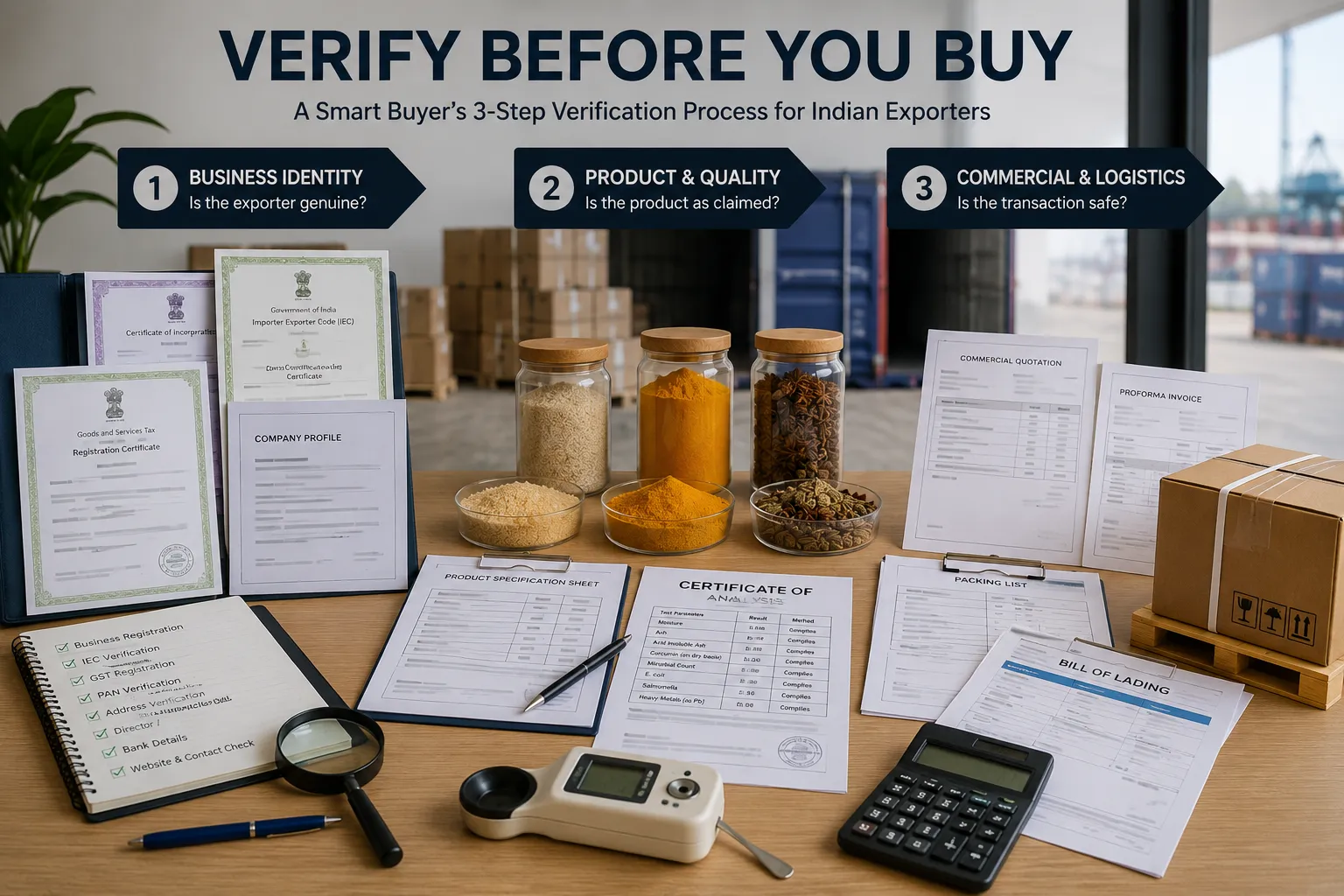
Before placing a commercial order or making an international payment, buyers should verify the supplier's business identity, export credentials, product specifications, quality process, documentation, commercial terms and communication.
This does not mean that every buyer needs to perform a complicated investigation.
A structured supplier verification checklist can help an importer identify inconsistencies early and make a better-informed sourcing decision.
Quick Answer: How Do You Verify an Indian Exporter?
An international buyer can verify an Indian exporter by checking:
- Company and trade name
- Importer Exporter Code (IEC)
- GST registration details
- Udyam registration where applicable
- Business address and contact information
- Product specifications
- Samples and quality documentation
- Commercial quotation
- Payment instructions
- Packaging and shipment process
- Required export documents
- Communication consistency
No single document proves that a supplier will perform a successful transaction.
The objective is to check whether the supplier's identity, documentation, product information and commercial communication are reasonably consistent.
Why Should Buyers Verify an Indian Exporter?
International transactions involve distance, different legal systems, currency conversion, logistics and limited face-to-face interaction.
Supplier verification can help a buyer reduce avoidable risks such as:
- Incorrect company information
- Unclear product specifications
- Unexpected quality differences
- Incomplete documentation
- Payment-detail errors
- Misunderstandings about shipping terms
- Unrealistic commercial promises
- Poor communication
Verification should happen before making a significant commercial commitment.
Step 1: Check the Exporter's Legal or Trade Name
Start with the basic identity of the company.
Check whether the following information is consistent:
- Business name
- Trade name
- Business address
- Website
- Business email
- Telephone number
- Contact person
For a proprietorship, the legal proprietor name and trade name may be different.
Therefore, buyers should understand the relationship between the registered business identity and the trading name.
Step 2: Check the Importer Exporter Code
The Importer Exporter Code, commonly called IEC, is an important identifier for businesses engaged in import and export activity in India.
An international buyer can ask an Indian exporter to provide its IEC details and verify the information through the official Directorate General of Foreign Trade system.
A document should not be treated as trustworthy merely because a supplier sends a PDF.
Where official verification is available, buyers should use the relevant government source.
HMT Exim's IEC
HMT Exim's IEC certificate identifies:
- Firm Name: HMT Exim
- IEC: NSYPK4346E
- Nature of Concern: Proprietorship
- Date of Issue: 23 September 2025
- Issuing authority: Directorate General of Foreign Trade
- Office: Surat, Gujarat
The certificate itself states that updated IEC details can be checked through the official DGFT website.
This is the type of primary business information an international buyer can request from an Indian exporter.
Step 3: Check GST Registration
GST registration provides another useful business identity reference for Indian businesses that are registered under the GST system.
Buyers can compare:
- Legal name
- Trade name
- Business constitution
- Principal place of business
- GST registration number
The information should be reasonably consistent with the commercial information provided by the exporter.
HMT Exim's GST Registration
HMT Exim's GST Registration Certificate identifies:
- Legal Name: Hasti Hrithik Tibadiya
- Trade Name: HMT Exim
- Constitution: Proprietorship
- GSTIN: 24NSYPK4346E1Z4
- State: Gujarat
- Principal place of business: Surat, Gujarat
The certificate records the registration as a regular GST registration issued on 16 September 2025.
This illustrates an important point for buyers: the trade name shown on a website may differ from the legal name shown on government registration documents.
Step 4: Check Udyam Registration Where Applicable
Udyam registration is another business-registration reference that may be available for eligible Indian enterprises.
Buyers can compare the enterprise name and other available registration information.
HMT Exim's Udyam Registration
HMT Exim's Udyam Registration Certificate identifies:
- Enterprise: HMT EXIM
- Udyam Registration Number: UDYAM-GJ-22-0528832
- Enterprise Type: Micro for the 2025–26 classification year
- Major Activity: Trading
- NIC Code: 46909
- Registration Date: 1 September 2025
The certificate records the enterprise's registered business activity as trading.
For a buyer conducting supplier due diligence, this type of registration information can be one part of the overall verification process.
Step 5: Compare the Information Across Documents
One of the simplest checks is consistency.
Compare the information provided in:
- Website
- Quotation
- Proforma invoice
- IEC
- GST documentation
- Udyam documentation where applicable
- Bank details
- Email signature
Look for obvious inconsistencies in:
- Company name
- Trade name
- Address
- Contact information
- Legal entity
- Payment beneficiary
A difference does not automatically indicate a problem.
For example, a proprietorship can have a trade name that differs from the proprietor's legal name.
The important question is whether the relationship can be clearly explained and verified.
Step 6: Verify the Product Specification
Business registration does not prove product quality.
An exporter can be a legitimate business and still not be the right supplier for your specification.
Before ordering, confirm:
- Product name
- Grade
- Purity
- Moisture
- Mesh size
- Active parameters where applicable
- Colour
- Foreign matter
- Microbiological requirements
- Heavy metals where applicable
- Shelf life
- Packaging
The product specification should be written clearly rather than relying on phrases such as "premium quality."
Step 7: Request a Product Sample
Where practical, buyers should evaluate a sample before committing to a large order.
A sample can help assess:
- Appearance
- Colour
- Aroma
- Texture
- Purity
- Packaging
- Product-specific characteristics
For products with measurable technical parameters, laboratory testing can provide additional information.
A sample is not a guarantee that the final bulk shipment will be identical.
The final commercial specification should therefore be documented.
Step 8: Ask About Quality Control
Ask the exporter how the product is checked before shipment.
Depending on the product, this may include:
- Visual inspection
- Purity testing
- Moisture testing
- Mesh testing
- Product-specific laboratory parameters
- Microbiological testing
- Heavy-metal testing where applicable
- Packaging inspection
For turmeric, for example, a buyer may require a defined curcumin percentage, moisture level and mesh size.
For psyllium husk, the buyer may specify purity, mesh and swelling characteristics.
The quality-control process should correspond to the actual product specification.
Step 9: Request Appropriate Quality Documentation
Depending on the product and destination, buyers may request documents such as:
- Certificate of Analysis
- Laboratory test report
- Certificate of Origin
- Phytosanitary certificate where applicable
- Fumigation certificate where applicable
- Other destination-specific documentation
Not every shipment requires every certificate.
The required documentation depends on the product, destination country and applicable regulations.
Step 10: Review the Export Quotation
A professional quotation should clearly state the commercial terms.
Look for:
- Product
- Specification
- Quantity
- Unit price
- Total price
- Currency
- Packaging
- Incoterm
- Port
- Payment terms
- Quotation validity
- Expected lead time
Do not evaluate a supplier only by the lowest price.
A low product price may not represent the lowest total landed cost.
Step 11: Understand the Incoterm
The quotation should identify the agreed Incoterm.
Common international trade terms include:
- EXW
- FOB
- CFR
- CIF
These terms affect the responsibilities and cost allocation between buyer and seller.
For example, FOB and CIF are not simply two different prices for the same transaction.
They allocate transportation-related responsibilities differently.
Buyers should therefore understand what is included before comparing quotations.
Step 12: Verify Payment Instructions Carefully
Payment verification is particularly important.
Before making an international payment:
- Confirm the beneficiary name
- Confirm the bank account details
- Confirm the bank name
- Confirm the currency
- Confirm the invoice number
- Confirm any changes through an independent communication channel
If bank details suddenly change by email, the buyer should verify the change independently before transferring funds.
Do not rely only on an email saying that payment details have changed.
Step 13: Understand the Exporter's Payment Terms
Ask the supplier to explain:
- Required advance payment
- Balance payment
- Payment timing
- Currency
- Bank charges
- Conditions for releasing shipping documents
The commercial payment structure should be clearly documented before the transaction begins.
Step 14: Check the Exporter's Communication
Communication quality is an underrated part of supplier verification.
Pay attention to whether the exporter:
- Answers questions directly
- Understands the product specification
- Provides consistent information
- Shares documents clearly
- Explains shipping terms
- Responds within a reasonable timeframe
- Corrects mistakes transparently
A supplier does not need to respond instantly to every message.
However, repeated contradictions or inability to answer basic product questions deserve further investigation.
Step 15: Ask Who Handles the Shipment
Understand how the exporter manages the shipment.
Ask about:
- Freight forwarder
- Port of loading
- Container booking
- Export documentation
- Customs procedures
- Packaging
- Container loading
- Shipping documents
This helps the buyer understand what happens after the order is confirmed.
Step 16: Confirm the Destination Requirements
The buyer should identify the requirements of the destination country.
Depending on the product, this can include:
- Import permits
- Product standards
- Lab testing
- Labelling
- Phytosanitary requirements
- Fumigation requirements
- Food regulations
- Customs documentation
The exporter and importer should discuss these requirements before shipment.
The buyer remains responsible for understanding the applicable import requirements in the destination market unless otherwise agreed.
Step 17: Start With a Controlled Commercial Relationship
When establishing a new supplier relationship, some buyers prefer to begin with a smaller trial order before moving toward larger recurring volumes.
This can allow both parties to evaluate:
- Product quality
- Packaging
- Documentation
- Communication
- Shipment handling
- Delivery performance
The appropriate order size depends on the product, commercial risk and buyer's requirements.
Red Flags That Deserve Further Investigation
A buyer should investigate further if a supplier:
- Refuses to provide basic company information
- Provides inconsistent company names
- Cannot explain its legal or trade identity
- Refuses reasonable product specifications
- Avoids written quotations
- Changes bank details unexpectedly
- Promises unrealistic delivery times
- Makes unsupported certification claims
- Pressures the buyer into immediate payment
- Cannot explain basic shipment responsibilities
One warning sign does not automatically mean that a supplier is fraudulent.
Multiple unexplained inconsistencies are more significant.
What Does Not Prove That an Exporter Is Reliable?
Several things can look impressive without proving commercial reliability.
These include:
- A professional website
- Social media followers
- Attractive product photographs
- Large claims about global markets
- Very low prices
- Generic "100% quality" statements
- Long product lists
These can support credibility, but they should not replace actual verification.
A Practical Indian Exporter Verification Checklist
Before placing a significant international order, a buyer can work through this checklist:
- ☐ Company identity checked
- ☐ Trade name understood
- ☐ IEC checked
- ☐ GST information checked where applicable
- ☐ Udyam information checked where applicable
- ☐ Business address reviewed
- ☐ Product specification confirmed
- ☐ Sample evaluated
- ☐ Quality documentation reviewed
- ☐ Quotation reviewed
- ☐ Incoterm understood
- ☐ Payment terms documented
- ☐ Bank details independently verified
- ☐ Destination requirements checked
- ☐ Shipping process understood
- ☐ Required export documents confirmed
HMT Exim: Example of Transparent Supplier Information
HMT Exim is a proprietorship operating from Surat, Gujarat.
Its official business documentation provides several independently identifiable registration references.
The IEC certificate identifies HMT Exim as the firm name and records its nature of concern as a proprietorship.
Its GST Registration Certificate identifies HMT Exim as the trade name and records the business constitution as a proprietorship.
Its Udyam Registration Certificate identifies HMT EXIM as a micro enterprise for the 2025–26 classification year and records trading as the major activity.
These documents do not by themselves guarantee a successful transaction or prove every aspect of supplier performance.
They provide verifiable business information that a prospective buyer can use as part of a broader supplier due-diligence process.
That distinction is important.
A professional exporter should not ask buyers to rely only on marketing claims.
The buyer should be encouraged to verify the relevant information.
What Should an International Buyer Ask an Indian Exporter?
A buyer can begin with these questions:
- What is your registered business name?
- What is your trade name?
- Can you provide your IEC details?
- Can you provide applicable GST information?
- What product specification do you supply?
- Can you provide a sample?
- What quality tests are performed?
- Can you provide the applicable COA?
- What packaging options are available?
- Which Incoterms can you quote?
- Which port will the shipment move from?
- What documents will accompany the shipment?
- What are the payment terms?
- What is the expected preparation timeline?
- What destination-specific requirements should be considered?
A supplier who understands these questions should be able to explain the relevant parts of the transaction clearly.
Frequently Asked Questions
How do I verify an Indian exporter?
Check the company's identity, IEC, applicable GST and Udyam information, business details, product specifications, quality documentation, quotation, payment details and shipment process. Use official government sources wherever possible.
What is an IEC?
IEC stands for Importer Exporter Code. It is an identifier issued by India's Directorate General of Foreign Trade for businesses engaged in import and export activities.
Can I verify an Indian company's GST details?
Where applicable, buyers can use the relevant official GST verification mechanisms to check registration information.
What is Udyam registration?
Udyam registration is the Indian government registration system for eligible micro, small and medium enterprises. It can provide another business reference when available.
Should I verify the supplier before sending payment?
Yes. Significant supplier and payment details should be verified before making an international commercial payment.
Is a company website enough to verify an exporter?
No. A website is useful for understanding the company, but it should be combined with official business information, product documentation and commercial verification.
Should I request an IEC certificate?
It is reasonable for an international buyer to request the exporter's IEC details and verify the information through the appropriate official source.
Should I ask for a sample before a bulk order?
For many products, sample evaluation is a sensible step before a large commercial order, especially when product quality is important.
Does business registration guarantee product quality?
No. Business registration establishes business information; it does not guarantee that a specific product lot meets the buyer's technical requirements.
How can I reduce risk when importing from India?
Use supplier due diligence, clear product specifications, sample approval where appropriate, documented commercial terms, appropriate quality testing, verified payment instructions and clear shipping documentation.
Final Buyer Checklist
Before placing an international order with an Indian exporter, remember:
Verify the company.
Verify the product.
Verify the commercial terms.
Verify the payment instructions.
Verify the documentation.
Verify the shipment requirements.
Do not rely on a single document or a single online profile.
Good international sourcing is based on multiple pieces of consistent information.
Looking for an Indian Export Supplier?
HMT Exim is an India-based trading and export business operating from Surat, Gujarat.
If you are an international buyer sourcing Indian spices or agricultural products, share your required product, specification, quantity, packaging and destination.
HMT Exim can discuss the requirement and provide the relevant commercial information for evaluation.
Related HMT Exim resources: reliable turmeric supplier | complete export process from India