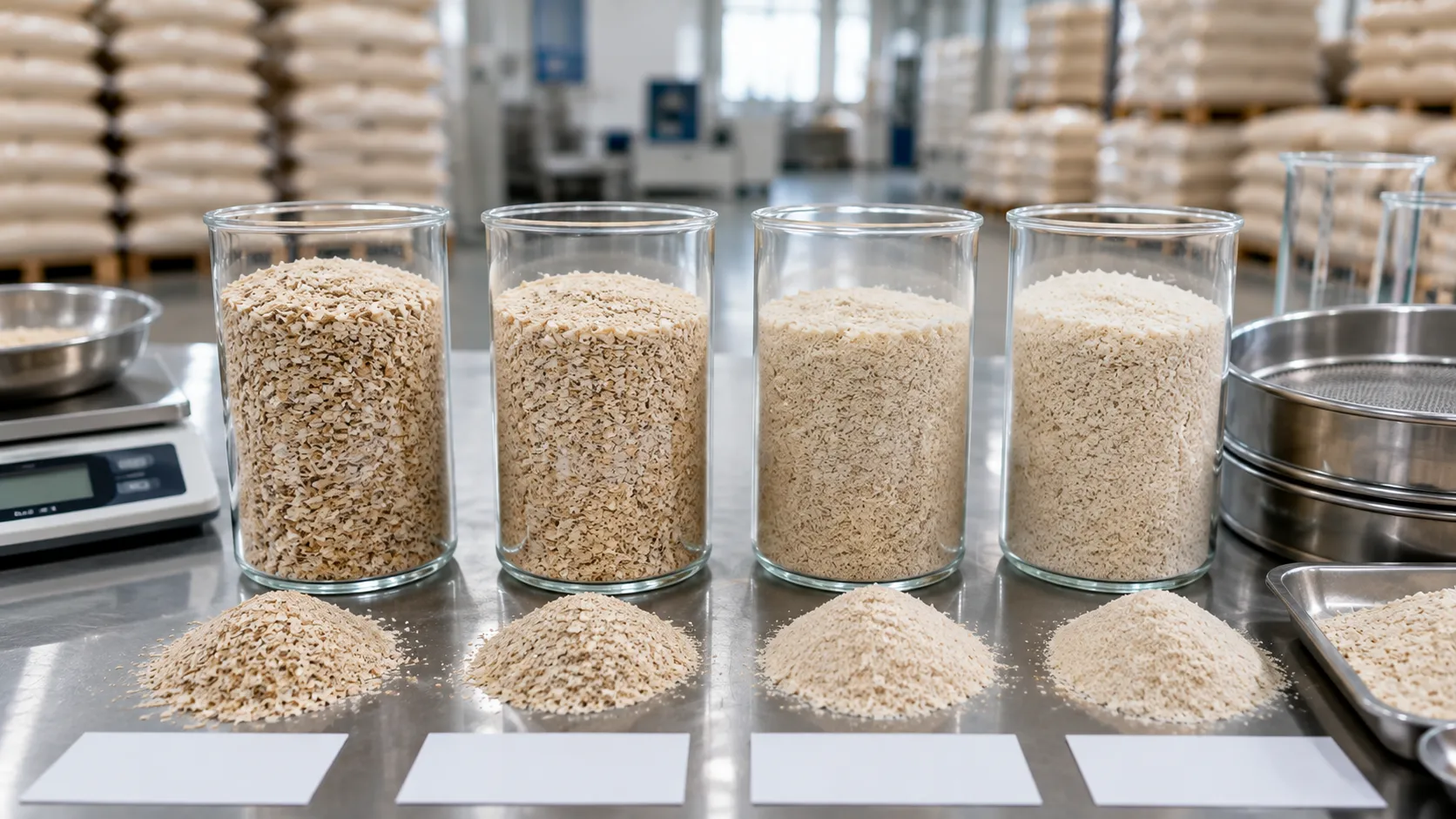
Psyllium Husk and Psyllium Husk Powder come from the same plant source, but they are not interchangeable in every application. The difference is primarily related to the physical form and degree of processing, which can affect particle size, handling, blending, formulation and packaging requirements.
For international buyers, choosing between Psyllium Husk and Psyllium Husk Powder should start with the intended application and required specification rather than simply comparing the price per kilogram.
Quick Answer: Psyllium Husk vs Psyllium Husk Powder
Psyllium Husk generally refers to the cleaned husk material in its flake-like or naturally separated form.
Psyllium Husk Powder is a more finely processed form in which the husk has been milled to a specified particle size.
The two products can have different physical characteristics and may be selected for different manufacturing and formulation requirements.
What Is Psyllium Husk?
Psyllium Husk is the outer husk of the seed of Plantago ovata. It is widely traded as a plant-based dietary fibre ingredient and is used in food and other ingredient applications.
For B2B sourcing, the buyer should define the required purity, physical form, moisture, particle characteristics and other quality requirements before requesting a commercial quotation.
What Is Psyllium Husk Powder?
Psyllium Husk Powder is produced by further processing Psyllium Husk into a finer particle size.
The degree of milling and the resulting particle-size specification can affect how the powder behaves during handling, blending, dispersion and formulation.
Because powder is a processed physical form, buyers should specify the required mesh or particle-size range rather than simply asking for fine Psyllium.
Key Differences Between Psyllium Husk and Powder
| Parameter | Psyllium Husk | Psyllium Husk Powder |
|---|---|---|
| Physical form | Husk or flake-like material | Finely milled powder |
| Particle size | Relatively larger natural husk structure | Smaller particles determined by milling specification |
| Processing | Cleaning and separation-focused processing | Additional milling or grinding |
| Handling | Different flow and bulk-density characteristics | Can behave differently because of finer particles |
| Application | Suitable where whole husk form is required | Suitable where a finer ingredient form is preferred |
| Specification | Purity, moisture and physical characteristics | Purity, moisture, mesh or particle size and physical characteristics |
Why Does Particle Size Matter?
Particle size can influence how an ingredient behaves during manufacturing. A finer powder can distribute differently from larger husk particles and may be selected for applications where a more uniform powder form is required.
However, finer does not automatically mean better. The appropriate particle size depends on the formulation, processing equipment and final product requirements.
Buyers should therefore specify the desired mesh or particle-size range when requesting Psyllium Husk Powder.
Does Psyllium Husk Powder Have Different Quality Requirements?
The core quality requirements can overlap, but powder buyers may need additional physical specifications because milling changes the particle characteristics of the ingredient.
Depending on the application, buyers may evaluate:
- Purity
- Moisture
- Particle size or mesh
- Swelling characteristics
- Colour and appearance
- Foreign matter
- Microbiological parameters
- Packaging
- Certificate of Analysis
The exact specification should be established according to the buyer's intended application and destination market.
Which Form Is Better for Food Manufacturing?
There is no universal answer. Food manufacturers may choose Psyllium Husk or Psyllium Husk Powder depending on their production process and formulation requirements.
A product developer should consider how the ingredient needs to be incorporated into the final product, how it will be handled during production and what particle size is appropriate for the formulation.
The correct choice is therefore application-specific.
Which Form Is Better for Nutraceutical Applications?
Nutraceutical and dietary-fibre applications can also require different physical forms depending on the finished product and manufacturing process.
Buyers should establish the intended dosage form, processing method, required particle size and applicable quality requirements before selecting the raw material.
Where the ingredient will be used in a regulated food or nutraceutical product, the buyer should also confirm the requirements applicable in the destination market.
Psyllium Husk vs Powder: What Should Buyers Ask Suppliers?
Before requesting a quotation, provide the supplier with a clear specification.
- Required product form
- Required purity
- Required particle size or mesh
- Moisture requirement
- Swelling requirement where applicable
- Microbiological requirements
- Packaging format
- Required quantity
- Destination country
- Required quality documentation
Giving the supplier these details makes it easier to receive a comparable quotation instead of receiving different products under similar names.
How to Compare Psyllium Husk and Powder Prices
Price per kilogram should not be the only comparison.
When comparing quotations, buyers should consider the product form, purity, particle-size specification, packaging, quantity, testing requirements, shipping terms and destination.
A lower price for a different physical specification is not necessarily a better commercial offer.
For broader sourcing guidance, see our Psyllium Husk B2B sourcing guide.
How Does Psyllium Husk Powder Relate to Psyllium Husk Grades?
Buyers may encounter grade specifications such as 85%, 95%, 98% and 99% in commercial Psyllium sourcing. These grade terms and the physical form of the product are separate considerations.
A buyer should therefore specify both the required grade or purity specification and whether the requirement is for Psyllium Husk or Psyllium Husk Powder.
Our guide to Psyllium Husk grades from 85% to 99% explains how buyers can approach grade selection.
Quality Testing Before Bulk Purchase
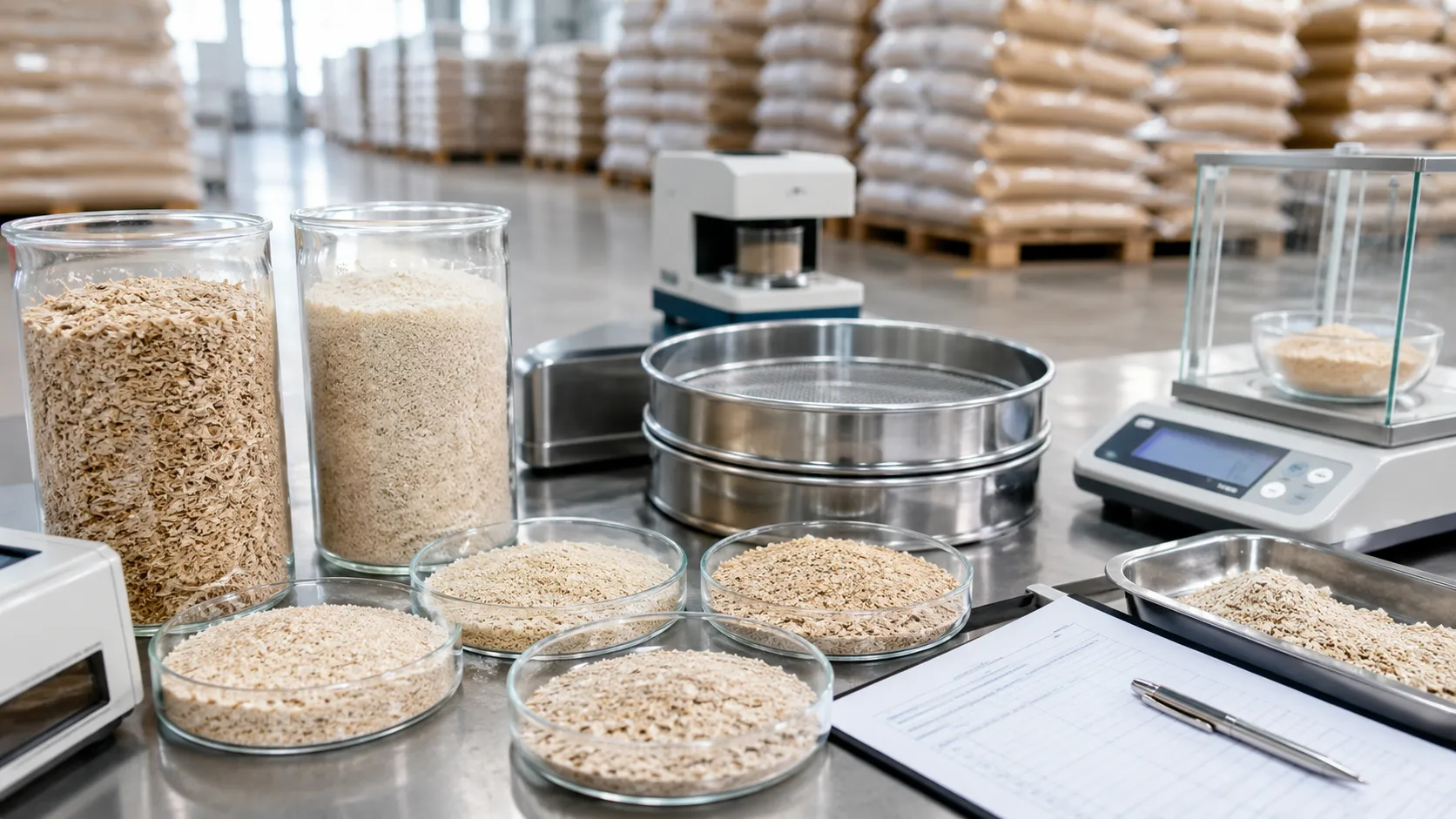
For a new supplier relationship, buyers should evaluate a representative sample against the agreed product specification before committing to a large commercial quantity.
Important checks can include purity, moisture, particle size, appearance, swelling characteristics and applicable microbiological or safety parameters.
Buyers should also review the supplier's Certificate of Analysis and confirm that the commercial shipment will be produced against the agreed specification.
Psyllium Husk vs Powder Buying Checklist
- ☐ Required physical form is defined
- ☐ Psyllium Husk or Psyllium Husk Powder is clearly specified
- ☐ Purity requirement is defined
- ☐ Mesh or particle-size requirement is defined where applicable
- ☐ Moisture requirement is defined
- ☐ Swelling requirement is defined where applicable
- ☐ Microbiological requirements are confirmed
- ☐ Packaging is agreed
- ☐ Representative sample is evaluated
- ☐ COA requirements are agreed
- ☐ Commercial quotation matches the required specification
- ☐ Destination-market requirements have been reviewed
How to Choose Between Psyllium Husk and Powder
Choose the physical form based on the way the ingredient will be used.
If the application requires the natural husk structure, Psyllium Husk may be the appropriate specification. If the manufacturing process requires a finer and more uniform ingredient, Psyllium Husk Powder may be more suitable.
The decision should be based on formulation requirements, processing conditions, particle size, quality specifications and commercial considerations.
Bulk Psyllium Husk and Psyllium Husk Powder From India
HMT Exim supports B2B sourcing requirements for Indian Psyllium products. Buyers can review the Psyllium Husk product information and discuss the required physical form, grade, quantity, packaging and destination.
For buyers with a specific product requirement, the HMT Exim contact page can be used to share the required specification, quantity and destination.
Frequently Asked Questions
Is Psyllium Husk the same as Psyllium Husk Powder?
No. They come from the same plant source, but Psyllium Husk Powder is a more finely processed physical form of the husk.
Which is finer, Psyllium Husk or Psyllium Husk Powder?
Psyllium Husk Powder is generally finer because it has undergone additional milling. The exact particle size should be specified by the buyer.
Is Psyllium Husk Powder better than Psyllium Husk?
Not necessarily. The appropriate form depends on the intended application and manufacturing process.
Can I use Psyllium Husk instead of Psyllium Husk Powder?
Not automatically. Substitution should be evaluated according to the formulation, processing method and required physical characteristics.
What should I specify when buying Psyllium Husk Powder?
Buyers should define purity, mesh or particle size, moisture, applicable swelling requirements, microbiological specifications, packaging and quantity.
Final Takeaway
Psyllium Husk and Psyllium Husk Powder are related products but serve different physical and processing requirements. The main distinction is the degree of processing and resulting particle size, not simply a difference in product quality.
For international B2B sourcing, buyers should specify the physical form, purity, particle size, quality parameters, packaging and destination requirements before comparing quotations.
If you know whether you need Psyllium Husk or Psyllium Husk Powder, along with your quantity and destination, contact HMT Exim to discuss your sourcing requirement.