Choosing the right export product is one of the biggest decisions for any new exporter. Many businesses select products based only on local availability or low prices, but successful exports usually begin with market demand, supplier strength, compliance and long-term commercial potential.
Whether you are starting your first export business or expanding into new markets, selecting the right product can significantly improve your chances of building sustainable international sales.
This guide explains a practical framework for choosing export products from India that international buyers actually purchase.
Why Product Selection Matters
Not every product that sells well domestically becomes a successful export product.
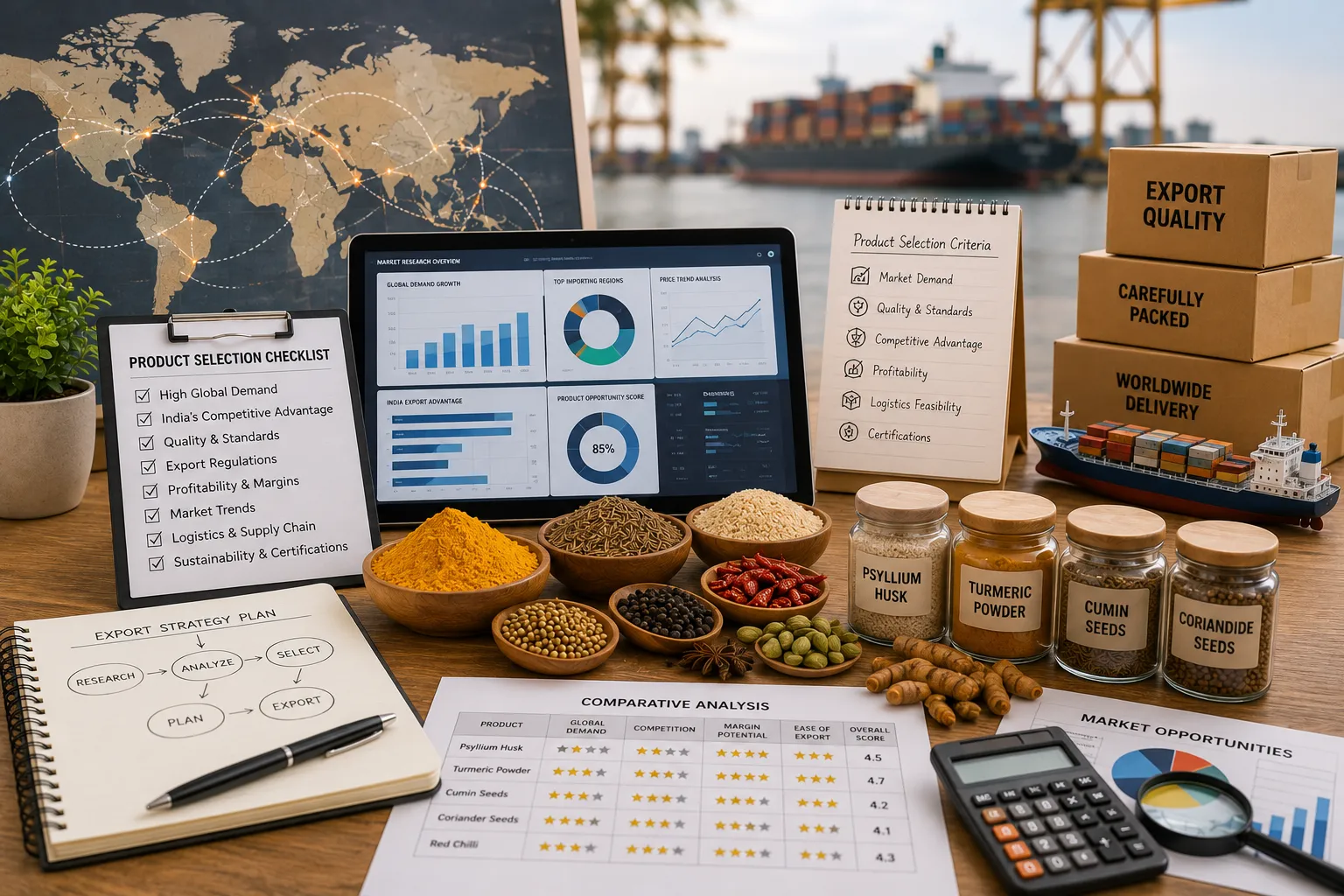
Professional exporters usually evaluate:
- Global demand
- Import trends
- Competition
- Profit potential
- Logistics
- Regulatory requirements
- Supplier reliability
Choosing the right product means balancing demand with your ability to supply it consistently.
Step 1: Start With International Demand
Instead of asking, "What can I sell?", ask "What are buyers already importing?"
Good demand indicators include:
- Growing import volumes
- Multiple importing countries
- Repeat purchasing industries
- Stable long-term demand
Products used by food manufacturers, wholesalers and ingredient companies often create repeat business opportunities.
Step 2: Study the Competition
A large market alone does not guarantee success.
Evaluate:
- Major supplying countries
- India's export position
- Price competition
- Quality expectations
- Packaging standards
Sometimes a smaller but less competitive market can provide better opportunities than a crowded one.
Step 3: Choose Products With Repeat Demand
Products purchased repeatedly often provide stronger long-term export opportunities.
Examples include:
- Food ingredients
- Spices
- Functional ingredients
- Industrial raw materials
Repeat-demand products can create ongoing buyer relationships instead of one-time transactions.
Step 4: Evaluate Profit Margins
Export profitability depends on more than the supplier price.
Calculate:
- Product cost
- Packaging
- Transportation
- Documentation
- Port charges
- Freight
- Commercial terms
A complete cost calculation gives a more realistic picture of export profitability.
Step 5: Check Supplier Availability
A product with excellent demand becomes difficult to export if reliable suppliers cannot consistently meet quality and quantity requirements.
Look for suppliers that can provide:
- Consistent quality
- Commercial quantities
- Quality documentation
- Export-ready packaging
Building a reliable supplier network is often more valuable than finding the cheapest supplier.
Step 6: Understand Export Regulations
Every product has different export requirements.
Depending on the product and destination, requirements may include:
- Import Export Code
- FSSAI compliance where applicable
- Phytosanitary requirements
- Country-specific regulations
- Certificates of Origin
Understanding compliance early prevents shipment delays later.
Step 7: Consider Logistics
Logistics directly affect export costs and delivery performance.
Evaluate:
- Container suitability
- Product shelf life
- Storage requirements
- Shipping routes
- Destination ports
Products that travel well often reduce logistics complexity.
Step 8: Match the Product to Your Business Model
Some exporters manufacture products themselves, while others operate as merchant exporters.
Understanding your business model helps determine how you source products and work with suppliers.
Our guide on Merchant Exporter vs Manufacturer Exporter explains these two approaches in detail.
Step 9: Choose Products You Can Differentiate
Competing only on price is difficult.
Look for ways to differentiate through:
- Quality consistency
- Documentation
- Packaging
- Private-label support
- Professional communication
Even commodity products can become more competitive when supported by reliable export management.
Step 10: Validate Before Scaling
Before investing heavily, validate your product with real buyers.
Practical validation steps include:
- Research buyers
- Request feedback
- Share specifications
- Send samples where appropriate
- Test commercial interest
This reduces the risk of building inventory before confirming market demand.
What Makes a Good Export Product?
| Factor | Why It Matters |
|---|---|
| Global demand | Creates sales opportunities |
| Repeat purchasing | Supports long-term business |
| Reliable suppliers | Improves consistency |
| Export compliance | Reduces shipment risk |
| Commercial margins | Supports profitability |
| Manageable logistics | Simplifies exports |
Export Products With Strong Long-Term Potential
India offers opportunities across multiple export sectors.
Examples include:
- Spices
- Functional ingredients
- Botanical powders
- Agricultural products
- Industrial raw materials
Rather than chasing short-term trends, focus on products with sustainable international demand.
Why HMT Exim Focuses on Functional Ingredients
HMT Exim's export approach focuses on sourcing quality Indian products through supplier coordination, quality-focused inspections and export-ready packaging. The company's product catalog highlights Indian spices sourced from established production regions while emphasizing quality verification and export documentation.
Buyers interested in Indian functional ingredients can explore:
How to Find Buyers After Choosing a Product
Product selection is only the first step.
Once you choose a product, the next priority is building a qualified buyer pipeline.
Our guide on How to Find International Buyers for Indian Products explains practical buyer-generation methods.
Export Product Selection Checklist
- ☐ Global demand verified
- ☐ Competition analyzed
- ☐ Profitability calculated
- ☐ Reliable suppliers identified
- ☐ Compliance requirements reviewed
- ☐ Logistics evaluated
- ☐ Business model selected
- ☐ Product differentiation planned
- ☐ Buyer validation completed
- ☐ Export documentation understood
Frequently Asked Questions
What is the best product to export from India?
There is no single best product. The strongest opportunities usually combine international demand, reliable suppliers, manageable logistics and commercial profitability.
Should I choose a product based on local availability?
No. Local availability is helpful, but international demand and supplier reliability should drive the decision.
How do I validate an export product?
Research buyers, share specifications, gather feedback and confirm commercial interest before scaling.
Is being a merchant exporter enough to start exporting?
Yes. Merchant exporters can build export businesses by sourcing products through suitable supplier networks while managing export documentation and logistics.
What should I calculate before exporting?
Calculate product cost, packaging, freight, documentation and commercial terms before estimating profitability.
Final Takeaway
The right export product is one that matches international demand, reliable sourcing, commercial profitability and long-term buyer potential. Instead of selecting products based only on local availability or low prices, build a structured evaluation process that includes market research, supplier verification and buyer validation.
If you're exploring export opportunities in Indian functional ingredients and spices, contact HMT Exim to discuss sourcing requirements and international markets.