Turmeric may be a dry agricultural product, but export packaging plays an important role in protecting its quality from the time it leaves the supplier's facility until it reaches the buyer's warehouse.
For international buyers, packaging is not only about choosing a bag size. The packaging system should protect the turmeric from moisture, contamination, physical damage and unnecessary exposure during transportation and storage.
This guide explains the main packaging considerations for buyers sourcing turmeric from India, whether purchasing turmeric powder or whole turmeric fingers.
Why Turmeric Export Packaging Matters
International shipments can pass through multiple stages before reaching the final buyer: factory handling, inland transportation, container loading, ocean transit, port handling, customs clearance and warehouse unloading.
During this journey, unsuitable packaging can increase the risk of moisture exposure, torn bags, contamination or product loss.
A suitable export-packaging system therefore needs to match the product specification, shipment size, destination and buyer's handling requirements.
Common Bulk Packaging for Turmeric Exports
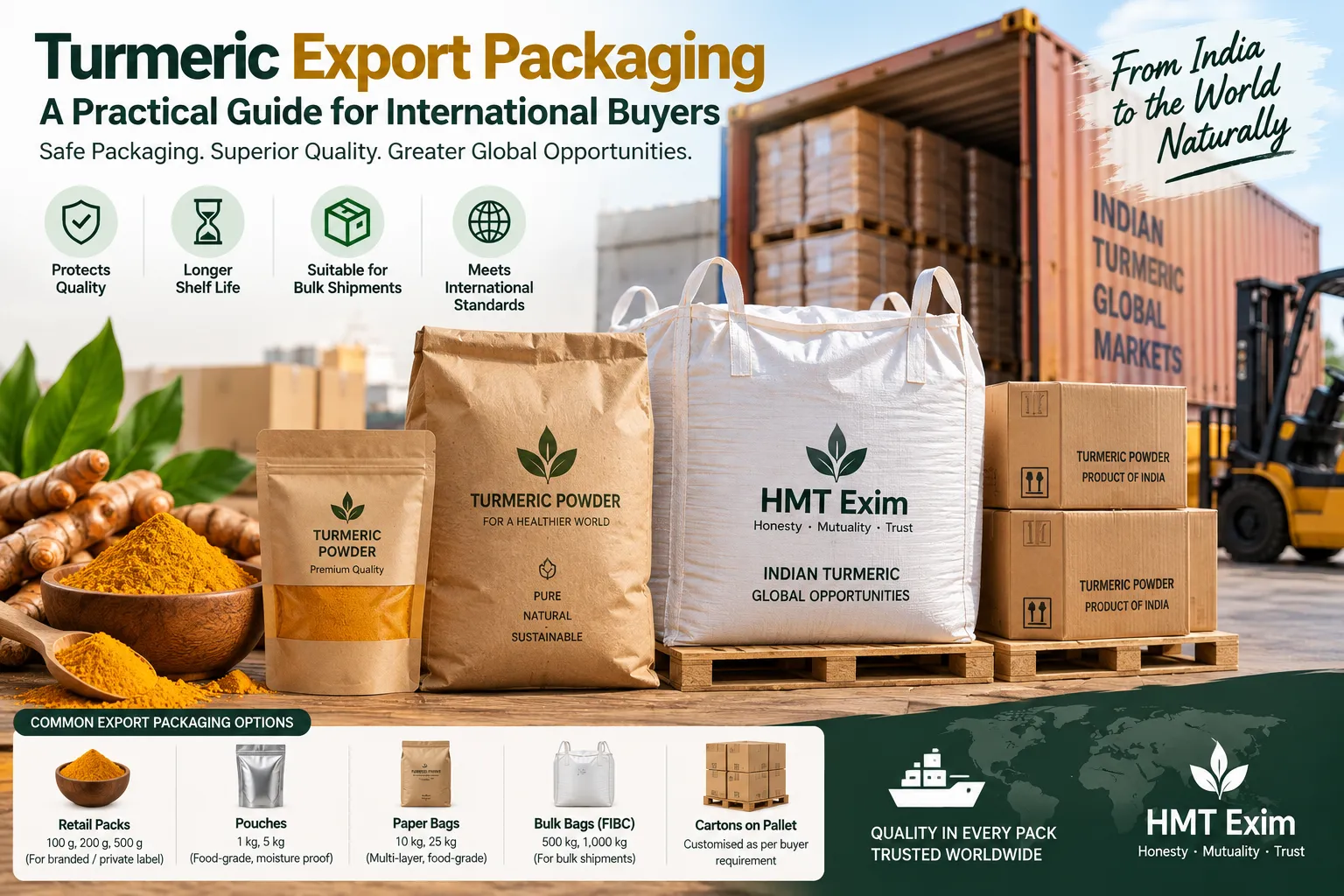
Bulk turmeric is commonly supplied in packaging formats selected according to the buyer's requirements and the intended application.
For commercial shipments, packaging may include woven PP bags, bags with suitable inner liners, vacuum-packed formats or other food-grade packaging systems where required.
HMT Exim's product information includes 25 kg and 50 kg PP bags, vacuum packs and private-label packaging among its packaging options. Exact packaging should be confirmed against the buyer's product and shipment requirements.
25 kg vs. 50 kg Turmeric Bags
Both 25 kg and 50 kg formats can be considered for bulk trade, but the practical choice depends on the buyer's warehouse, handling equipment, destination requirements and intended use.
There is no universal best bag size. Buyers should select a format based on their actual receiving and storage process.
Turmeric Powder Packaging
Turmeric powder requires packaging that helps protect the dry product from environmental exposure during transportation and storage.
For powder shipments, buyers should discuss the required bag construction, inner liner, closure and packing weight with the supplier before confirming the order.
Where the buyer has specific food-industry or regulatory requirements, those requirements should be incorporated into the packaging specification before production.
Whole Turmeric Finger Packaging
Whole turmeric fingers have different physical characteristics from powdered turmeric and may require a different packing approach.
The packaging should be strong enough for handling and transportation while providing appropriate protection from moisture, contamination and physical damage.
Buyers importing whole turmeric should confirm whether they require conventional bulk bags, lined bags or another agreed export format.
Why Moisture Protection Is Important
Turmeric is a dry agricultural commodity, so controlling environmental exposure during storage and transportation is an important packaging consideration.
Packaging should help reduce unnecessary exposure to moisture and maintain the agreed product condition throughout the shipment.
Buyers should also consider the climate of the destination country and the expected storage conditions after arrival.
Food-Grade Packaging Considerations
When turmeric is intended for food use, buyers should discuss packaging materials and handling practices appropriate for food ingredients.
The exact packaging specification should be agreed between buyer and supplier rather than assuming that every standard bulk bag has identical properties.
For regulated markets, importers should also verify whether their destination market has specific requirements concerning food-contact materials, labeling or packaging.
Inner Liners and Additional Protection
An inner liner can provide an additional barrier between the turmeric and the external packaging environment.
Whether an inner liner is necessary depends on the product, packaging material, shipping conditions and buyer specification.
For longer-distance shipments or destinations with challenging environmental conditions, buyers may wish to discuss additional moisture-protection measures with the supplier before finalizing the packing format.
Vacuum Packaging for Turmeric
Vacuum packaging can be considered when the buyer requires a packaging format designed to reduce the amount of air within the pack.
However, vacuum packaging is not automatically required for every turmeric export shipment. The appropriate format depends on the product, destination, shelf-life requirements, handling process and commercial specification.
Private Label Turmeric Packaging
Some international buyers require turmeric packed under their own brand rather than under the exporter's standard packaging.
Private-label packaging may involve customized bags, printed packaging, labels or other agreed presentation requirements.
These requirements should be discussed before production because artwork approval, minimum quantities, packaging material and printing arrangements can affect the order timeline and cost.
What Information Should Appear on Export Packaging?
Packaging and labeling requirements vary according to the destination market, product type and applicable regulations.
Depending on the shipment and market, buyers may need information such as:
- Product name
- Net weight
- Batch or lot identification
- Country of origin
- Manufacturer or exporter information where required
- Production or packing information where applicable
- Best-before or expiry information where required
- Storage instructions where applicable
Exact labeling requirements should be confirmed for the destination country before printing packaging materials.
Packaging and Container Loading
Packaging selection should also take container logistics into account.
Bags need to be loaded in a way that minimizes unnecessary movement and reduces the risk of damage during transportation. The loading plan can depend on bag dimensions, weight, palletization requirements and the buyer's unloading process.
Buyers should communicate any pallet, stacking or container-loading requirements before shipment preparation.
Palletized vs. Non-Palletized Shipments
Whether turmeric is shipped on pallets or loaded without pallets depends on the destination, buyer preference, container utilization strategy and handling facilities.
Palletization can make warehouse handling easier, while non-palletized loading may allow different use of container space. The practical choice should be made according to the complete logistics chain rather than packaging cost alone.
Packaging Should Match the Destination
A packaging format suitable for one market may not necessarily be ideal for another.
Importers should consider the destination climate, transit duration, warehouse conditions, local handling practices and applicable import requirements.
For example, a shipment travelling through humid conditions may require greater attention to moisture protection than one moving through a controlled dry environment.
What International Buyers Should Confirm Before Ordering
Before approving a turmeric export order, buyers should confirm the packaging specification in writing.
- Turmeric form: whole fingers or powder.
- Required net weight per bag.
- Outer packaging material.
- Inner liner requirements.
- Closure and sealing method.
- Food-grade requirements where applicable.
- Private-label or customized printing requirements.
- Label information required by the destination market.
- Palletization requirements.
- Container-loading and handling requirements.
Having these points agreed before production reduces avoidable changes later in the export process.
Packaging Does Not Replace Quality Control
Good packaging protects a product; it does not create product quality.
Buyers should evaluate turmeric separately for the specifications relevant to their application, such as variety, form, curcumin level, moisture and other agreed quality parameters.
For a broader discussion of turmeric quality grades, see 2%, 3%, 4% or 5% Curcumin Turmeric: Which Grade Is Right for Your Business?
Buyers can also review How Turmeric Powder Is Processed for Export from India to understand the processing side of export preparation.
Questions to Ask an Indian Turmeric Exporter
A serious B2B buyer can ask the supplier for a clear packaging specification before confirming the purchase.
- What packaging material will be used?
- Is an inner liner included?
- What is the net weight per bag?
- Can the packaging be customized?
- How will the bags be protected during container loading?
- Can packaging meet the destination market's labeling requirements?
- What batch identification will be provided?
These questions help turn packaging from a general discussion into a documented purchase requirement.
HMT Exim Turmeric Export Packaging
HMT Exim supplies turmeric from India for international B2B requirements and supports packaging options including 25 kg and 50 kg PP bags, vacuum packs and private-label formats, subject to product and order requirements.
Explore the Turmeric product offering or contact HMT Exim to discuss your required product form, packing size and export shipment requirements.
Frequently Asked Questions
What is the common packaging size for bulk turmeric exports?
Common commercial formats can include 25 kg and 50 kg bags, although the appropriate size depends on the buyer's handling and destination requirements.
Can turmeric be vacuum packed for export?
Yes, vacuum-packed formats can be considered where appropriate, but the need depends on the product, destination and buyer's packaging specification.
Can turmeric be exported under a buyer's private label?
Private-label packaging can be arranged when agreed between the buyer and supplier, subject to packaging, artwork, quantity and production requirements.
Does turmeric powder need an inner liner?
An inner liner may provide additional protection, but the requirement depends on the packaging material, product, shipment conditions and buyer specification.
Should turmeric bags be palletized?
Palletization depends on the buyer's warehouse, handling system, destination and logistics requirements. It should be agreed before shipment.
Final Takeaway
Turmeric export packaging should be treated as part of the overall product and logistics specification. The right packaging needs to protect the product while fitting the buyer's handling system, destination conditions and regulatory requirements.
Before placing a bulk order, confirm the bag size, material, liner, closure, labeling, customization and loading requirements in writing.
If you are sourcing turmeric from India, contact HMT Exim to discuss your required turmeric specification and export packaging.