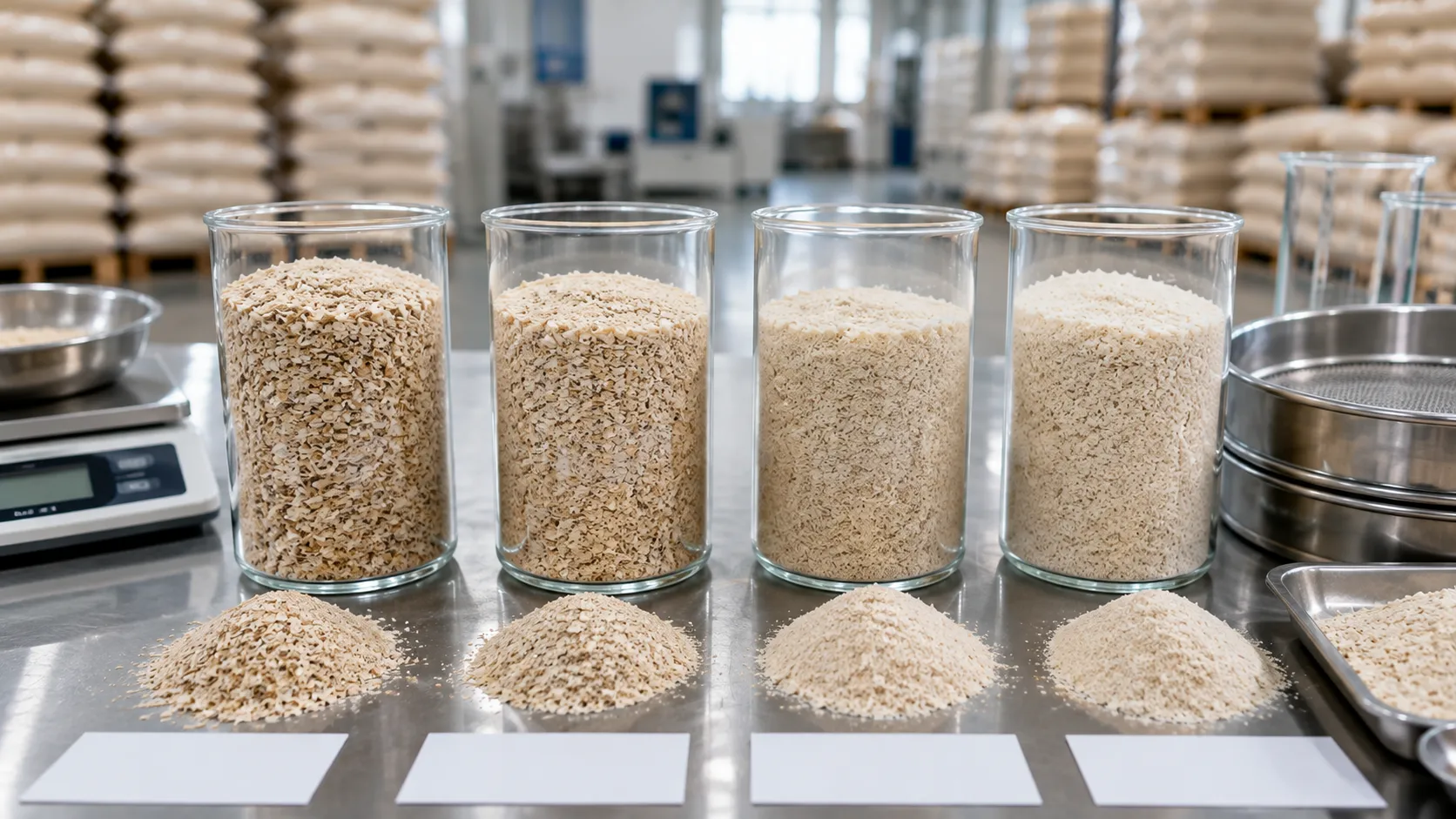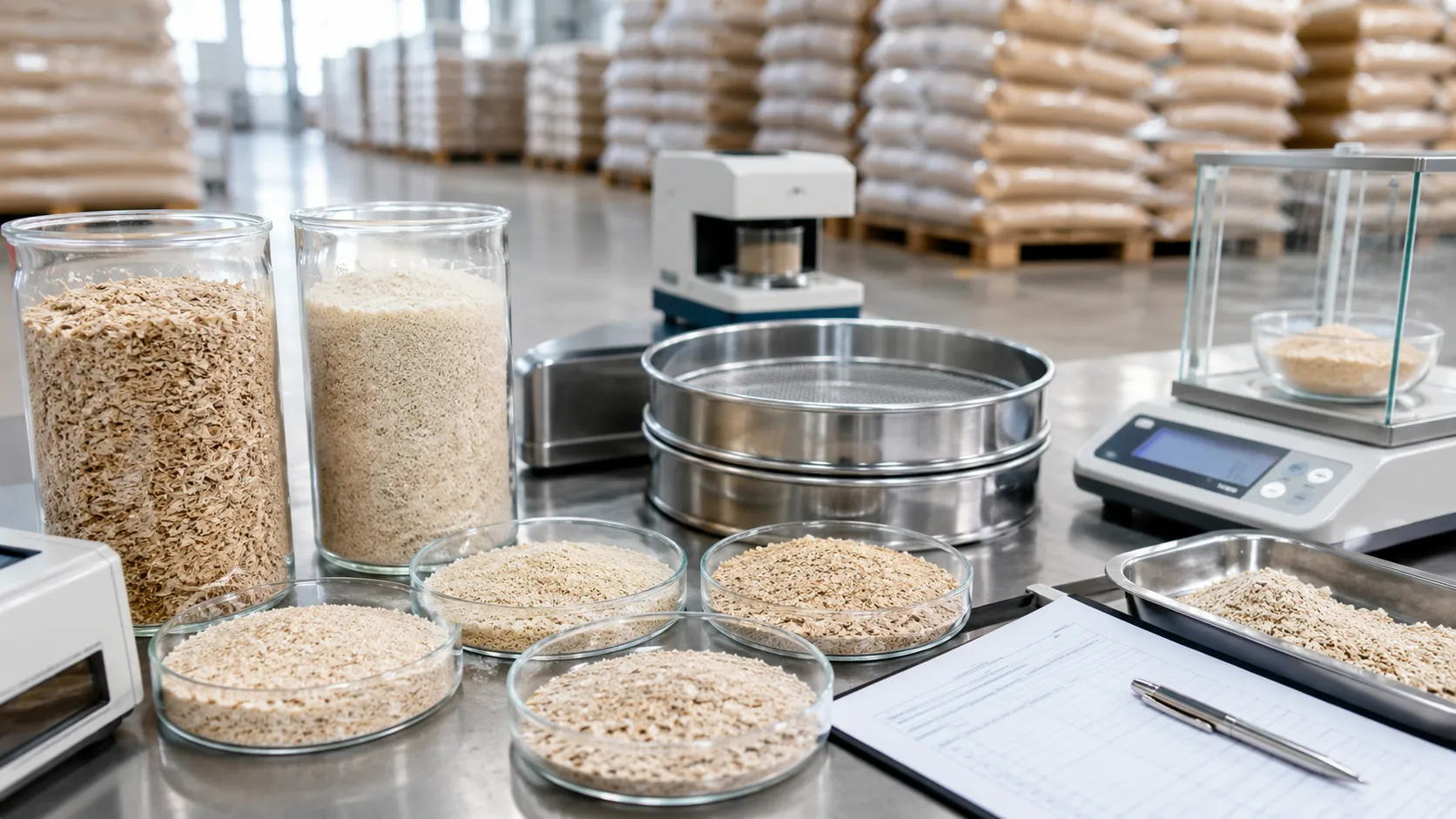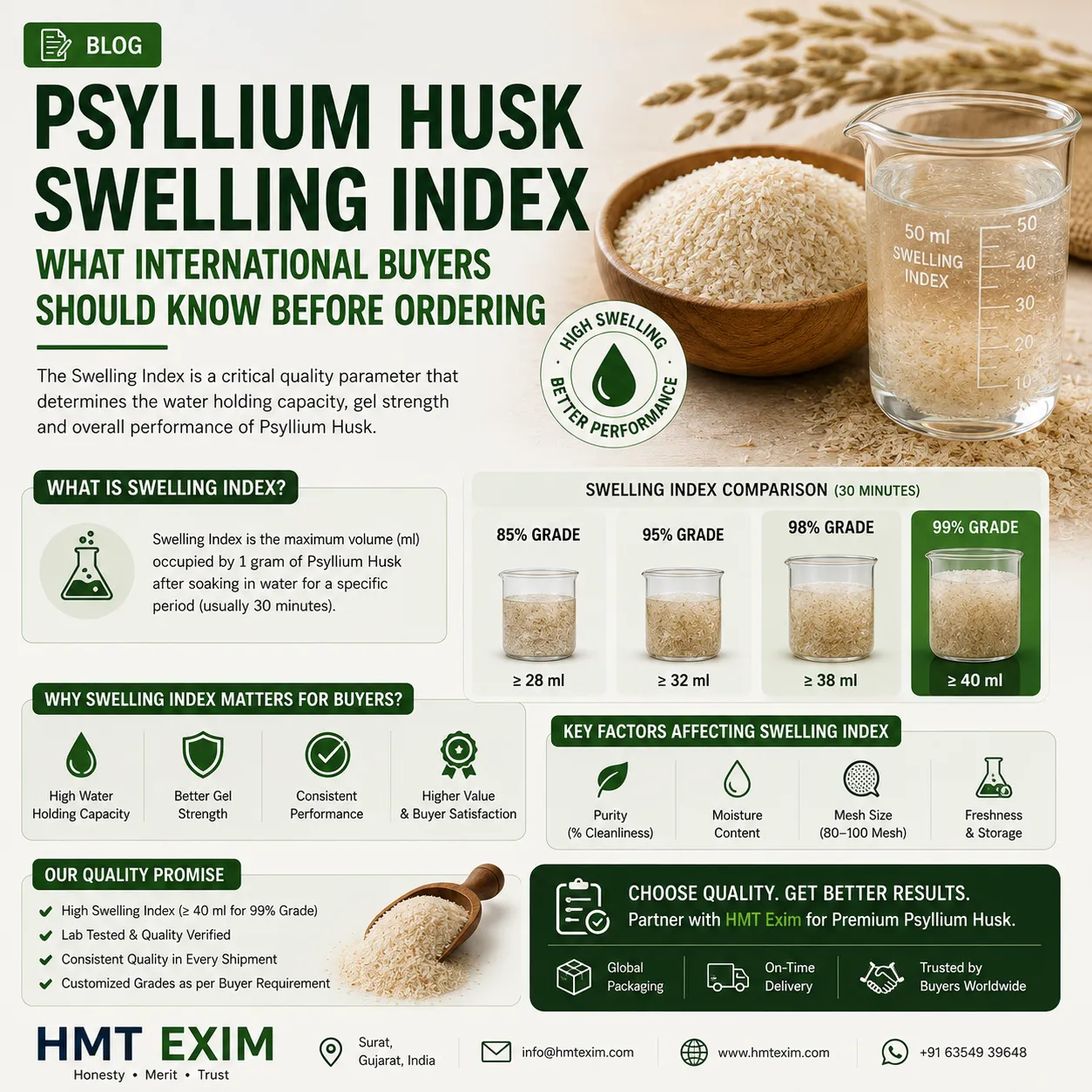
When international buyers request Psyllium Husk quotations, one quality parameter appears repeatedly alongside purity and mesh size: Swelling Index.
Many first-time exporters assume it is simply another laboratory number. In reality, swelling performance is often one of the key commercial indicators buyers use when evaluating product suitability.
This guide explains what swelling index means, why buyers ask for it and how exporters can use proper documentation to build confidence in international transactions.
What Is Swelling Index?
Swelling Index describes the ability of Psyllium Husk to absorb water and expand after hydration.
Instead of focusing only on appearance, buyers use swelling performance to understand how the product behaves during manufacturing and end-use applications.
It is particularly important because two batches that look similar visually may perform differently once hydrated.
Why International Buyers Ask for Swelling Index
Professional buyers often purchase Psyllium Husk for applications where hydration behavior matters.
Typical buyer priorities include:
- Product consistency
- Reliable formulation performance
- Batch-to-batch uniformity
- Quality verification
- Commercial confidence
Rather than relying only on supplier claims, many buyers request laboratory documentation supporting the agreed specification.
How Swelling Index Fits Into Export Quality
Swelling performance is one part of a broader quality evaluation.
Buyers usually evaluate these parameters together instead of relying on a single measurement.
Does a Higher Swelling Index Always Mean Better Quality?
Not necessarily.
The appropriate swelling requirement depends on:
- Product application
- Buyer specification
- Manufacturing process
- Commercial requirements
Instead of promising a fixed value to every customer, exporters should first understand the buyer's specification and then provide matching documentation.
How Is Swelling Performance Verified?
Buyers commonly expect documented testing rather than verbal claims.
Supporting documentation may include:
- Certificate of Analysis
- Batch identification
- Testing date
- Product specification
- Laboratory results where applicable
Providing transparent documentation helps reduce commercial disputes.
Swelling Index and Product Grades
Many buyers compare swelling performance alongside commercial grades.
However, exporters should avoid assuming that one grade automatically guarantees identical swelling behavior across every batch.
Our guide on Psyllium Husk Grades Explained explains how commercial grades differ from laboratory quality parameters.
How Swelling Performance Relates to Mesh Size
Another common misconception is that mesh size and swelling index are identical.
They measure different characteristics.
- Mesh Size describes particle size.
- Swelling Index describes hydration behavior.
Our article on Psyllium Husk 80 Mesh explains particle-size specifications in detail.
Questions Buyers Should Ask Suppliers
Before approving a bulk order, buyers should request:
- Product specification sheet
- Certificate of Analysis
- Batch information
- Purity details
- Mesh specification
- Moisture information
- Packaging details
These questions provide a stronger commercial foundation than discussing swelling performance alone.
How HMT Exim Supports Quality-Focused Buyers
HMT Exim supplies export-oriented Psyllium Husk with quality-focused sourcing, laboratory documentation where applicable, export-ready packaging and customer-focused shipment coordination. The company's product profile highlights commercial packaging options designed for international buyers.
Learn more on our Psyllium Husk product page.
Frequently Asked Questions
Why do buyers request swelling index?
It helps buyers understand how the product performs during hydration and manufacturing.
Is swelling index more important than purity?
Both are important. Professional buyers evaluate multiple quality parameters together.
Can exporters provide laboratory reports?
Many export shipments include laboratory documentation where required by the buyer.
Does mesh size affect swelling index?
They describe different product characteristics and should not be treated as the same specification.
Should buyers request a sample before placing a bulk order?
Yes. Sample approval helps verify that the product matches the agreed specification before larger commercial shipments.
Final Takeaway
Swelling Index is one of the most practical quality indicators international buyers use when evaluating Psyllium Husk.
Instead of focusing on a single number, professional sourcing decisions should combine swelling performance with purity, mesh size, moisture, laboratory documentation and supplier reliability.
If you're sourcing export-quality Psyllium Husk from India, contact HMT Exim to discuss your required specification, packaging and destination market.